You hear that? That clicking sound echoing through your basement? That is the sound of a mechanical heart failing to beat while the wind howls outside at thirty miles per hour. If you are reading this, you are probably wearing three layers of wool and wondering why your furnace is playing hard to get. I have spent thirty winters in this trade, most of them elbow-deep in rusted heat exchangers while my fingers went numb, and I can tell you right now: a pilot light that dies when the wind blows isn’t just a nuisance; it is a diagnostic red flag that your system’s physics are out of balance. Most guys will tell you it’s just a bad thermocouple, swap a part, and charge you three hundred bucks. They are the ‘Sales Techs’ I can’t stand. They don’t understand the Bernoulli principle or pressure differentials. They just know how to read a price book. We are going to do a forensic deep dive into why your gas-fired dinosaur is quitting on you.
The Physics Lesson: When Airflow Becomes the Enemy
My old mentor, a grizzly guy named Pop who smelled like WD-40 and menthol cigarettes, used to scream at me, ‘You can’t burn what you can’t breathe, and you can’t breathe if the wind is choking you!’ He’d stand over a furnace with a manometer and show me how a house is essentially a giant lung. This is the core of the Airflow Manifesto. When the wind hits your house, it creates zones of high and low pressure. If your venting is shoddy—if the tin knocker who installed your flue didn’t account for the roofline—that wind can actually create a backdraft. It’s not just a ‘breeze’ blowing out a candle; it’s a massive pressure imbalance pushing combustion gases back down the pipe. This is why preventative heating maintenance is critical; we check the draft pressure before the blizzard hits.
“The chimney or vent shall be so located and installed that it is not subject to the effects of down-drafts caused by adjacent buildings, topography, or other obstructions.” – NFPA 54 / ANSI Z223.1 National Fuel Gas Code
Thermodynamic Zooming: The Seebeck Effect
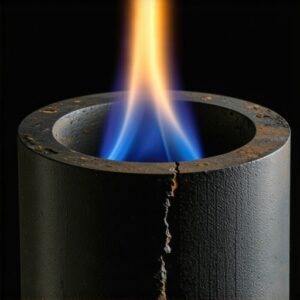
Let’s get technical for a second. Your pilot light doesn’t just sit there to look pretty. It heats a thermocouple—two dissimilar metals joined together that produce a tiny electrical charge, about 25 to 30 millivolts, when heated. This is the Seebeck effect. That tiny bit of ‘juice’ is what holds the gas valve open. If a gust of wind pulls the flame even a fraction of an inch away from that tip, the voltage drops, the magnet in the valve loses its grip, and click—the gas shuts off. If your system is older, you might need top HVAC repair strategies to address the pilot assembly’s sensitivity. Sometimes, the control board diagnostics will show a ‘flame rectification’ error, even on newer electronic ignition systems, because the wind is literally ‘lifting’ the flame off the sensor.
The Anatomy of a Wind-Blown Failure
In the North, where the polar vortex likes to park itself in your driveway, we deal with ‘Flame Rollout.’ This is the scary cousin of a dying pilot. If your vent is blocked by snow or the wind is creating too much backpressure, the flames can actually roll out of the combustion chamber. This is why crawl space heating solutions need to be perfectly vented; you don’t want carbon monoxide or fire hazard lurking under your floorboards. If your pilot keeps dying, check your chimney cap. If it’s missing or rusted through, the wind has a straight shot at your gas valve. We often see this in homes where the duct design services were an afterthought, leading to negative pressure in the mechanical room that ‘sucks’ the air right out of the furnace.
The Wiring and Capacitor Connection
While we are talking about electrical components, don’t let a tech talk you into capacitor replacement services for a pilot issue. Capacitors are for motors—they provide the ‘kick’ to get your blower or compressor moving. If your furnace starts but then the pilot dies, it’s a fuel or air issue. However, if the entire system is wonky, you might need a legitimate wiring repair for heating systems. Corroded wires or a bad ground can mimic pilot failure by interrupting the flame sensor signal. I’ve seen Sparkies (electricians) cross a neutral wire that caused the control board to hunt for a ground, shutting down the gas valve every time the wind vibrated the house. It’s a nightmare to find, but that’s why we use AI-driven HVAC optimization tools now to track those micro-fluctuations in voltage.
“All gas-burning appliances shall be vented in such a manner that all products of combustion are safely discharged to the outside atmosphere.” – ACCA Manual D & G Standards
Transitioning to Modern Solutions: Beyond the Pilot
If you are tired of babying a 20-year-old furnace, it might be time to look at the new era of thermodynamics. We are moving away from atmospheric burners (the ones with the open pilot lights) toward sealed combustion. Heat pump solutions are the future, specifically geothermal heat pump systems. Since they don’t rely on burning gas, the wind can’t blow them out. They use the constant 55°F temperature of the earth to move heat. No flues, no pilots, no ‘gas’ smells. If you stay with gas, look into inverter-driven compressors for your AC side and modulating gas valves for the heat. These systems adjust their output in 1% increments, meaning they can maintain a steady, wind-resistant flame that doesn’t just ‘blast’ on and off.
Ductwork and Mastic: The ‘Pookie’ Factor
You can have the best furnace in the world, but if your duct design services were handled by a hack, you’re losing 30% of your heat before it reaches the vents. I always tell homeowners to look for ‘Pookie’—that thick, gray mastic sealant. If you see silver tape (duct tape, which ironically shouldn’t be used on ducts), you have leaks. Leaky ducts in a cold crawlspace can create a vacuum in your house that pulls wind down the chimney, blowing out that pilot. It is all connected. You fix the ducts, you often fix the pilot. It’s about solar thermal heating integration and total home balance, not just swapping parts.
How to Tell if You’re Being Scammed
A ‘Sales Tech’ will walk into your mechanical room, see the pilot is out, and immediately start talking about ‘cracked heat exchangers’ to scare you into a $12,000 install. While heat exchangers do crack—and it’s dangerous—a pilot blowing out in the wind is usually a venting or thermocouple issue. If they don’t pull out a combustion analyzer or a camera to show you the crack, they are blowing smoke. Always check choosing the best heating service expert tips before signing a contract. A real tech will check the manifold pressure and the vent termination first. They’ll look at the control board diagnostics to see the history of the flame signal. They won’t just try to sell you the newest AI-driven HVAC optimization package if a $15 vent cap will fix the problem.
The Final Diagnosis
If your furnace is gasping for air every time the trees start swaying, stop hitting the reset button. You’re just dumping unburnt gas into the chamber. Check your venting, look for ‘Pookie’ on your ducts, and ensure your thermocouple isn’t caked in soot. If the problem persists, it’s a pressure imbalance that requires a pro who knows more than just how to use a screwdriver. Physics doesn’t care about your comfort; it only cares about equilibrium. Your job is to make sure that equilibrium happens outside your house, not inside your combustion chamber. “,”image”:{“imagePrompt”:”A close-up, high-detail macro shot of a furnace pilot light flame flickering blue and orange, with a slightly soot-covered copper thermocouple in the frame, set against the dark, metallic interior of a combustion chamber, moody lighting, industrial aesthetic.”,”imageTitle”:”Furnace Pilot Light and Thermocouple Diagnosis”,”imageAlt”:”A technical view of a furnace pilot light heating a thermocouple inside a gas-fired heater.”},”categoryId”:0,”postTime”:””}
“`