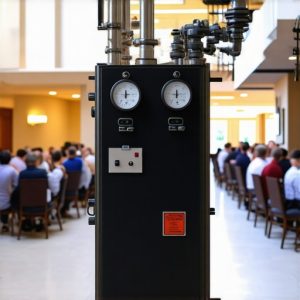
The Sound of a Silent Asset: When Your Commercial Furnace Quits
There is a specific kind of silence that happens in a commercial warehouse or an office block when the rooftop unit (RTU) or the basement boiler shudders to a halt in the dead of a Chicago-style winter. It is not just quiet; it is expensive. Within an hour, the sensible heat stored in the thermal mass of the building begins to bleed out into the frozen street. By the second hour, your tenants are complaining. By the fourth, you are staring at a repair quote that looks like the ransom note for a kidnapped king. But before you sign off on a five-figure invoice for a draft inducer motor repair or a full boiler repair services overhaul, you need to understand that thermodynamics does not care about your budget, and neither do ‘Sales Techs’ looking to hit their monthly commission.
The Physics of the Draft: A Mentor’s Lesson in Airflow
My old mentor, a man who had more soot in his lungs than a Victorian chimney sweep, used to bark at me every time I pulled a manifold out of my bag: ‘If you do not understand the draft, you do not understand the fire!’ He was right. You can swap out a furnace ignition repair kit every week, but if the atmospheric pressure differential is not pulling that flame through the heat exchanger, you are just burning money. This is the foundation of combustion analysis. In the cold North, we fight the ‘Draft War’ every day. If your quote includes a new inducer motor but the tech didn’t even check the static pressure of the flue, you are being taken for a ride. The draft inducer’s job is to create a negative pressure environment to safely vent carbon monoxide. If that motor is screaming like a banshee with a failing bearing, it is a mechanical failure. If it is humming but not moving air, you have a blockage or a cracked heat exchanger that is bypassing the pressure switch. Don’t let them hide a simple blockage under a $1,200 motor replacement fee.
“The most expensive equipment in the world cannot overcome a bad duct system.” – Industry Axiom
The Anatomy of a Bloated Commercial Quote
When you receive a quote for boiler repair services or hydronic heating systems, you need to look past the bottom line. Look for the ‘Miscellaneous Consumables’ line item. In the trade, we know that covers the ‘Pookie’ (mastic), some zip ties, and the tech’s lunch. If that number exceeds $200, you are paying for the company’s overhead, not your repair. Then there is the ‘Environmental Fee.’ Unless they are recovering high-pressure ‘gas’ (refrigerant) or disposing of hazardous old oil, this is often a fluff charge. In a hot water heater repair scenario, you might see a charge for ‘System Stabilization.’ That is literally just the tech waiting for the water to get hot. You shouldn’t be paying $150 an hour for a guy to watch a tank fill up.
The ‘Sales Tech’ Trap and the Capacitor Scam
I despise Sales Techs. These are the guys who show up with shiny boots and a tablet, but haven’t touched a pipe wrench in six months. They are trained to find ‘impending failures.’ If your quote for a simple wiring repair for heating systems suddenly mushrooms into a recommendation for a $20,000 system because of ‘micro-cracks’ in the heat exchanger that they can’t show you on a camera, walk away. A real tech will show you the CO readings on their calibrated analyzer. They will show you the flame rollout. They will show you why choosing the best heating service matters by providing empirical data, not just fear-mongering. For instance, a furnace ignition repair might just be a dirty flame sensor—a five-minute fix with some steel wool—but a Sales Tech will quote you a new control board and an igniter assembly.
Hydronic Realities and the Boiler Mythos
In hydronic heating systems, the complexity rises along with the potential for hidden fees. Because these systems involve fluid dynamics and thermal expansion, a ‘Sparky’ (electrician) might be needed for the pumps, but the ‘Tin Knocker’ (duct guy) stays home. If you see a quote for ‘Air Purge’ that costs more than the actual pump replacement, be wary. While air in the lines is the enemy of heat transfer, a modern commercial system should have automatic air scoops. You are paying for the physics of the system to do its own job. Always check if your boiler repair services include a water chemistry test. If they aren’t checking the PH and glycol levels, they aren’t doing the job right, and your new parts will be corroded by next season.
“Commercial boilers shall be maintained in accordance with the manufacturer’s recommendations to ensure an AFUE rating that meets or exceeds the design thermal efficiency.” – ASHRAE Standard 155
The Hidden Value of HEPA and Humidity
Often, a contractor will try to ‘bundle’ HEPA filter systems or whole-home humidifiers (or commercial-scale steam humidifiers) into a repair quote. They claim it protects the new equipment. While it is true that cleaner air reduces the load on the evaporator coil (and prevents the acidic buildup that eats through heat exchangers), these should be separate conversations. A whole-home humidifier is a comfort and health upgrade, not a requirement for your furnace to stop short-cycling. If they tell you the warranty is void without a $3,000 air scrubber, they are lying. However, checking your warranty service plans is vital. Sometimes, the ‘hidden fee’ isn’t a fee at all, but a missed opportunity for the manufacturer to pick up the tab for the parts.
The ‘Sparky’ Factor: Wiring and Control Boards
When it comes to wiring repair for heating systems, the diagnostic time is where they get you. It takes time to trace a 24v short in a commercial rooftop unit with five miles of wire. A fair quote will cap diagnostic hours. A predatory one will leave it open-ended. If the tech says, ‘I think it’s the board,’ ask them which relay failed. If they can’t point to a scorched trace or a failed coil on the board, they are ‘parts swapping’ on your dime. This is why preventative heating maintenance is the only way to avoid these emergency ‘guess-work’ invoices. A tech who knows the system’s history won’t have to guess.
Climate Context: The Northern Polar Vortex
Since we are dealing with boilers and furnaces, we are in the North. The enemy here is ‘Flame Rollout’ and ice. During a polar vortex, your high-efficiency furnace vents can freeze over. A tech might quote you for a new inducer motor when all you really needed was for someone to kick the icicle off the PVC pipe outside. Always look for ‘Manometer Testing’ on your quote. This proves the tech actually measured the pressure the motor is fighting against. For more on keeping things running, check out top HVAC repair strategies to extend your systems life. If you are considering a full shift in tech for 2025, look at heat pump solutions for efficient home comfort in 2025, though in the deep North, you’ll still want that gas backup for when the mercury hits thirty below.
The Final Verdict on Vetting Your Quote
Before you sign, ask for the ‘As-Found’ and ‘As-Left’ combustion readings. A professional commercial outfit will provide a printout from their Testo or Bacharach analyzer showing the CO, O2, and stack temperature. If they can’t provide that, they aren’t technicians; they are just guys with wrenches. Make sure they have a clear privacy policy regarding your building’s data and that their warranty service plans are clearly outlined in writing. If you’re still unsure, you can always contact us for a second opinion on a complex commercial bid. Remember, in the world of heavy iron and high-pressure steam, the loudest guy in the room is usually the one trying to hide a lack of technical knowledge. Trust the physics, check the static pressure, and never pay for ‘gas’ you didn’t actually lose.