The Ghost in the Vents: Why Your Expensive Unit is Failing You
I remember my first week in the field, shivering in a crawlspace in the middle of a Northeast winter, watching my mentor, Old Man Miller, stare at a furnace that was cycling on high-limit every three minutes. The homeowner was furious; she’d just spent six thousand on a high-efficiency furnace, yet her living room was a meat locker. Miller didn’t look at the burners or the gas valve. He grabbed me by the collar and pointed at a 10-inch return flex duct that was kinked like a garden hose. ‘Kid,’ he growled, ‘you can’t heat what you can’t move. You can have a million BTUs of fire, but if the air can’t touch the heat exchanger and get to the rooms, you’ve just got an expensive paperweight.’ That was my first lesson in the Airflow Manifesto: Physics doesn’t care about your brand name; it only cares about static pressure.
When we talk about How to Maximize Airflow with Better Duct Design Services, we aren’t just talking about moving air; we are talking about the fluid dynamics of comfort. In cold climates like Chicago or New York, the enemy isn’t just the temperature—it’s the friction. Your furnace is a heart, but your ducts are the arteries. If those arteries are clogged, undersized, or poorly routed, the ‘heart’ works twice as hard and dies half as fast. This is why furnace repair services often end up being band-aids for deeper architectural failures in the ductwork. If your blower motor is screaming like a banshee, it’s likely because it’s trying to pull air through a straw.
“The most expensive equipment in the world cannot overcome a bad duct system.” – Industry Axiom
The Thermodynamic Zoom: Heat Exchange and Latent Reality
To understand why duct design matters, you have to understand the heat exchanger. In a furnace, we’re dealing with sensible heat—the stuff you feel on your skin. If the airflow is too low, the heat exchanger gets too hot, the metal expands too much, and eventually, it cracks. A cracked heat exchanger isn’t just a repair; it’s a carbon monoxide death sentence. This is why furnace ignition repair and regular maintenance are vital, but they don’t solve the root cause of low flow. We use airflow measurement services to check the External Static Pressure (ESP). Most residential blowers are rated for 0.5 inches of water column. I’ve walked into houses where the ESP was 0.9 or 1.2 because some ‘tin knocker’ thirty years ago thought a single 12×12 return was enough for a 3-ton system. It’s not.
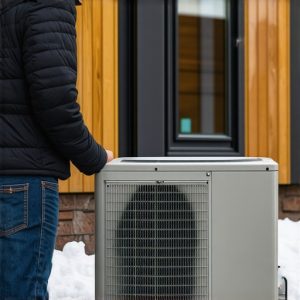
In the North, we also deal with massive humidity swings. During the summer, your AC or heat pump acts as a giant dehumidifier. If the air moves too fast over the evaporator coil, it doesn’t stay long enough to reach the dew point. The result? Sensible cooling without latent removal. You get a house that’s 72 degrees but 70% humidity—the dreaded ‘cold swamp’ effect. Proper dehumidification services often start with slowing down the fan or resizing the supply plenums to ensure the coil can actually do its job. If you are considering a heat pump installation in a cold climate, duct design becomes even more critical because heat pumps move more air at lower temperatures than gas furnaces. You can learn more about these transitions in our guide on heat pump solutions for efficient home comfort in 2025.
The Blueprint of a High-Performance Duct System
Most duct systems are built by the lowest bidder. They use ‘Pookie’ (mastic) to hide sins and tape that fails after two seasons. To maximize airflow, we look at three things: The Return, The Plenum, and The Runouts. 1. The Return Air Drop: This is where most systems fail. If the return is too small, the blower is starved. We often see ‘oil-canning’ where the metal pops and bangs because the vacuum pressure is too high. 2. The Trunk Line: It should be sized using the Equal Friction Method. As air is dropped off at each vent, the duct should decrease in size to maintain velocity. 3. The Transitions: Air hates 90-degree turns. Every sharp corner is like a brick wall to a molecule of air. Turning vanes and long-radius elbows are the marks of a pro.
For those managing larger facilities, school boiler maintenance often reveals that the air handling units are fighting decades of poor duct modifications. Whether it’s a classroom or a living room, the physics remains the same. If you’re seeing uneven temperatures, it might be time for thermostat wiring upgrades to support multi-stage equipment or app-controlled heating systems that can manage dampers in a zoned setup. However, no smart thermostat can fix a crushed pipe in the attic. You need a tech who knows how to use a manometer, not just a screwdriver.
“Airflow is the primary medium of heat transfer in residential HVAC systems; without proper volume and velocity, efficiency ratings are purely theoretical.” – Manual D, ACCA
Protecting the Investment: Maintenance and Warranties
I’ve seen ‘Sales Techs’ try to sell a homeowner a whole new system because a capacitor blew or a limit switch tripped. They won’t tell you that the switch tripped because the filter was a ‘high-MERV’ 1-inch pleated nightmare that choked the system to death. Before you sign a contract for a $15,000 replacement, look at top hvac repair strategies to extend your systems life. A simple warranty service plan can often catch these airflow issues before they cook your compressor. Check out top HVAC repair strategies for more on this. Regular preventative heating maintenance is the only way to ensure that your ‘gas’ (refrigerant) and your airflow are in a perfect thermodynamic dance. You can find a detailed checklist at preventative heating maintenance for 2025.
If you are struggling with a system that sounds like a jet engine but doesn’t keep you warm, or if you’re worried about the health of your furnace, don’t wait for the first polar vortex to hit. Professional choosing the best heating service expert tips for 2025 suggests looking for companies that prioritize static pressure testing over sales pitches. You can contact us to schedule a true diagnostic of your home’s lungs. Remember, comfort isn’t just about the box outside; it’s about the air you breathe and how it gets to you. For information on how we handle your data, see our privacy policy.