The Airflow Manifesto: Why Your High-Efficiency Unit is Failing You
Look, I’ve spent more time in 140-degree attics than most people have spent in their living rooms. My old mentor, a grizzly guy named Dutch who could sniff out a refrigerant leak from the curb, used to bark at me every time I grabbed a manifold gauge set too early: ‘Kid, you can’t cool what you can’t touch! Air is the blood, the ducts are the veins, and right now, this house is bleeding out.’ He was right. You can buy the most expensive 20-SEER 2025 heat pump installation, but if your ductwork looks like a colander, you’re just cooling the spiders in your crawlspace. Most ‘Sales Techs’ will try to sell you a new compressor the second they see a 15-year-old unit struggling. They don’t want to talk about static pressure because they don’t know how to measure it. They want a commission on a $12,000 box. But the physics don’t care about their sales quotas. If your static pressure is through the roof because your tin knocker didn’t size the return air drops correctly, or if 30% of your conditioned air is escaping into the attic, your new unit will die a premature death from high head pressure and liquid slugging.
“The most expensive equipment in the world cannot overcome a bad duct system. Proper duct design and sealing are the foundation of all thermal comfort.” – Industry Axiom
Thermodynamic Zooming: The Physics of the Leak
Let’s talk about enthalpy and sensible heat. In a dry climate like the Southwest, we are primarily fighting sensible heat—the temperature you see on the thermostat. However, during the monsoon season, latent heat (humidity) creeps in. When your ducts leak in the attic, the Venturi effect kicks in. As the blower motor pushes air through the supply lines, the holes in your return ducts act like a vacuum, sucking in 130-degree, dust-laden attic air. This bypasses your filter and slams into your evaporator coil. Suddenly, that coil, which is supposed to be dropping the air temperature below the dew point to remove heat, is overwhelmed. The ‘gas’ or refrigerant in the suction line—which should be ‘beer can cold’—starts to warm up before it ever hits the compressor. This causes the compressor to run hotter, thinning out the oil and grinding those internal bearings into a screeching halt. This is why top hvac repair strategies must always begin with the envelope, not just the mechanicals.
The AeroSeal Solution: Surgery Without the Scalpel
Until recently, fixing a leak meant a ‘tin knocker’ crawling through fiberglass insulation with a bucket of ‘Pookie’ (mastic) and a brush, trying to reach corners that are physically impossible to touch. It was messy, incomplete, and frankly, a nightmare. AeroSeal changed the math. Instead of trying to fix the ducts from the outside, we seal them from the inside. We block off all the registers and pressurize the entire duct system with a non-toxic, aerosolized sealant. These microscopic particles don’t just float around; they are engineered to stay in suspension until they hit an area of high turbulence—a leak. As the air escapes through a crack, the particles collide and bond to the edges of the hole, building up a permanent, rubberized seal. We’re talking about sealing holes up to 5/8ths of an inch. It’s the difference between trying to patch a tire from the outside while it’s spinning and using a high-tech sealant that finds the puncture for you. This is a critical component of preventative heating maintenance because it ensures that every BTU your furnace or heat pump produces actually reaches your bedroom.
“Standard duct leakage in residential buildings can account for as much as 25% to 40% of the heating or cooling energy used by the HVAC system.” – ASHRAE Standards
The Southwest Struggle: Sensible Heat and the Monsoon Effect
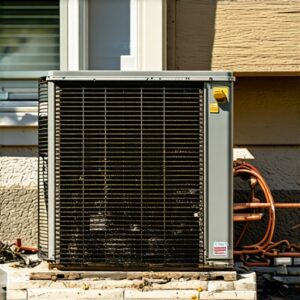
In our climate, the heat is a physical weight. When 115-degree ambient air cooks your outdoor condenser, your head pressure skyrockets. If your ducts are leaking, you are forcing your system to work in ‘overdrive’ just to maintain a measly 78 degrees indoors. This is where many homeowners get scammed. A tech comes out, sees the high head pressure, and tells you that you need a total replacement. They might even try to bypass a choosing the best heating service protocol just to close the deal. But often, the compressor is fine—it’s just suffocating. By sealing the ducts and ensuring proper heat pump solutions, we lower the TESP (Total External Static Pressure), allowing the blower to move the correct CFM (Cubic Feet per Minute). This keeps the compressor cool and prevents the dreaded ‘acidic’ smell of a burnout. If you have rooms that never get cold, it’s not a ‘horsepower’ issue; it’s a ‘static’ issue. Closing vents in those hot rooms actually makes the problem worse by increasing pressure and forcing more air out of the leaks in the attic.
The Economics of Airflow
Let’s look at the math. A typical heating service call for a system that isn’t keeping up often results in a recommendation for more ‘juice’ (refrigerant). But if you have a leak in your ducts, you’re just paying to cool the neighborhood. AeroSeal can reduce duct leakage by up to 90%. That translates to a 20-30% reduction in your utility bill. More importantly, it stops the infiltration of dust, pollen, and attic insulation fibers into your breathing air. When we combine duct sealing with proper system design and attic insulation for heating, we create a thermal envelope that actually holds its ‘charge.’ Whether you’re dealing with evaporative cooler services during the dry months or gas line installation for furnaces in the winter, the ductwork is the common denominator. Don’t let a Sparky or a Sales Tech tell you otherwise—airflow is the only thing that matters in the end. Comfort is a matter of physics, and physics doesn’t lie.