The End of the Toaster Element: A New Era in Thermodynamic Efficiency
Listen, I’ve spent three decades staring at ‘toaster strips’—those electric resistance heaters that kick in when a standard heat pump gives up the ghost at thirty degrees. They are the most expensive way to heat a home, period. My old mentor used to scream at me in the middle of a frozen crawlspace, ‘You can’t cool what you can’t touch, and you can’t heat what you can’t compress!’ This is why airflow matters more than horsepower. He was right. Back then, we relied on brute force, but the physics of 2025 have changed the game. We are currently facing a regulatory cliff where the old R-410A ‘juice’ is being phased out for A2L refrigerants, and the efficiency standards for cold climates have skyrocketed. If you are still relying on a 10kW heat strip to keep your toes warm during a blizzard, you’re essentially burning dollar bills to stay warm. Cold Climate Heat Pumps (CCHPs) have finally solved the problem that plagued our industry for forty years: the loss of capacity as the mercury drops.
“The most expensive equipment in the world cannot overcome a bad duct system.” – Industry Axiom
The Physics of Vapor Injection and Low-Ambient Heating
When we talk about CCHPs, we aren’t just talking about a bigger compressor. We are talking about Enhanced Vapor Injection (EVI). In a standard system, as it gets colder outside, the refrigerant density drops. The compressor struggles to find enough ‘gas’ to move heat into your home. A CCHP uses a secondary heat exchanger and an electronic expansion valve (EEV) to inject a bit of vapor back into the middle of the compression cycle. This keeps the discharge temperature down and allows the compressor to move more mass at lower temperatures. It’s like a turbocharger for your HVAC. This technology allows these units to maintain 100% capacity down to 5°F or even lower. This is why heat pump solutions for efficient home comfort in 2025 are focused on these inverter-driven systems. We don’t need backup resistance heat anymore because the unit doesn’t lose its ‘muscle’ when the polar vortex hits. However, if your HVAC repair strategies don’t include checking the EEV or the contactor, you’re going to have a bad time. A simple contactor repair can be the difference between a running system and a frozen pipe catastrophe.
Why Airflow and Insulation are the Unsung Heroes
You can buy the fanciest CCHP on the market, but if your attic insulation for heating is subpar or your HVAC duct sealing looks like a ‘tin knocker’ had a bad day, you’re wasting energy. Thermodynamics is a balance. If the heat we pump in leaks out of the ceiling or the ducts, the system short cycles. I’ve seen garage heater installation jobs where the homeowner wondered why their bill was $400 because they didn’t seal the door to the house. It’s the same for your main system. You need to treat your home as a sealed envelope. If you’re switching from old tech, you might even consider propane conversion services or biomass boiler services as alternatives, but for most, the heat pump is the future. For those with larger properties, boiler maintenance services are still critical, but even those are being integrated into hybrid heat pump systems now. The key is reducing the ‘latent’ load and the ‘sensible’ loss. If we don’t seal the ducts with ‘pookie’ (mastic), we are just heating the squirrels in the attic.
The Economics of the Transition
The A2L transition means prices are going up. If you are looking for expert tips for choosing heating services, you need to find a tech who understands the new mildly flammable refrigerants like R-454B. These units require new leak sensors and specific training. Buying the cheapest unit this year is a trap because the serviceability of older R-410A units will become a nightmare as the gas becomes scarce. I often tell my customers that preventative heating maintenance is the only way to avoid the $12,000 ‘surprise’ in January. Whether it’s fireplace insert services to supplement your main heat or a full occupancy sensor installation to reduce waste in empty rooms, the goal is efficiency. I’ve even seen commercial restaurant kitchen exhaust repair scenarios where the heat loss through the hood was so high the heat pump couldn’t keep up. Every part of the building works together.
“Standard 62.1 requires specific ventilation rates that must be balanced against the thermal load to maintain indoor air quality without sacrificing efficiency.” – ASHRAE Standards
The Verdict on Cold Climate Heat Pumps
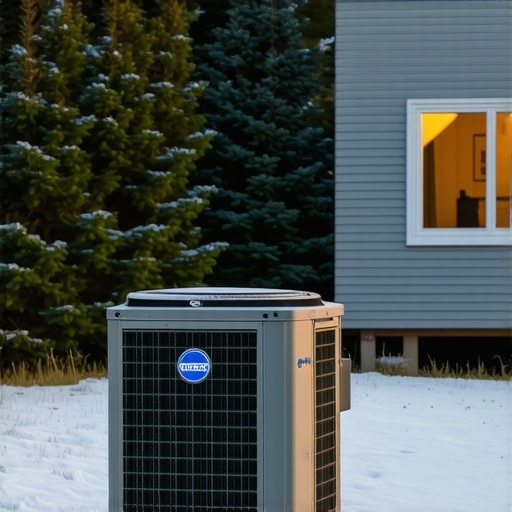
If you’re in a northern climate, the ‘sparky’ who tells you that you need 20kW of backup heat is living in 1995. With proper HVAC duct sealing and a high-efficiency inverter, you can ride out a sub-zero night without ever seeing your electric meter spin like a top. Don’t be fooled by ‘Sales Techs’ who try to push oversized equipment to compensate for poor insulation. Do the math, check your Manual J, and trust the physics of vapor injection. If you have questions about your specific setup, you can always contact us to talk shop. The ‘suction line’ should be beer-can cold in the summer, but in the winter, that discharge line needs to be screaming hot, and only a CCHP can do that efficiently when the world is frozen over. [image placeholder: A high-tech inverter heat pump compressor unit sitting in a snowy landscape, showing the frost-free coil and vapor injection lines]