The Ghost in the Ductwork: Why Your Carbon Footprint is a Physics Problem
My old mentor, a guy who had been crawling through crawlspaces since the R-12 days, used to grab me by the collar and scream, ‘You can’t cool what you can’t touch, and you can’t heat what you’ve already thrown away!’ At the time, I thought he was just another cranky tin knocker who’d spent too much time breathing in PVC primer fumes. But after thirty years of watching warehouse heating solutions fail because of literal holes in the logic of the system, I realized he was preaching the gospel of thermodynamics. Most people think their carbon footprint is about the number on the thermostat. They’re wrong. Your footprint is actually dictated by how much unconditioned outside air your system is forced to ‘eat’ and then vomit back out into the atmosphere.
The Airflow Manifesto: Beyond the Thermostat
In a massive facility or a complex hospital HVAC zoning setup, the biggest energy thief isn’t a bad compressor—it’s the ventilation strategy. Traditional systems are ‘dumb.’ They are designed for peak occupancy, meaning they suck in enough outside air to keep a thousand people breathing even if only ten people are in the building. Imagine heating a frozen Minnesota winter gust from -10°F up to 70°F just to exhaust it five minutes later. That is the definition of insanity. This is where Demand Controlled Ventilation (DCV) steps in. It uses CO2 sensors to tell the dampers exactly how much fresh ‘juice’ the building needs. It’s not magic; it’s just not being stupid with your CFM (Cubic Feet per Minute).
“The most expensive equipment in the world cannot overcome a bad duct system or an uncontrolled ventilation rate that ignores the actual sensible heat load of the occupants.” – Modified Industry Axiom
When we perform static pressure testing, we often find that systems are choking. High static pressure is like trying to breathe through a cocktail straw while running a marathon. If your DCV system isn’t calibrated, those dampers might stay wide open, forcing the blower motor to work double-time against a wall of resistance. That’s how you kill a motor and spike a utility bill in one season.
The Cold Climate Heat Pump Reality Check
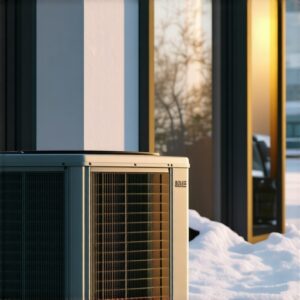
In the North, we deal with the ‘Polar Vortex’ effect. If you’re running heat pump solutions for efficient home comfort in 2025, you need to understand the balance point. Older heat pumps gave up when it hit 30°F, switching to ’emergency heat’ (which is just a fancy way of saying ‘expensive electric toaster coils’). Modern cold climate heat pumps can pull heat out of thin air even at -15°F, but they only work if the envelope is tight. If your DCV isn’t managed, you’re just using that high-tech heat pump to warm up the neighborhood. I’ve seen guys install a heating service miracle only to have it defeated by a 20% outdoor air intake that never closes.
Refrigerant Leak Detection and the Acidic Truth
Let’s talk about the ‘Sales Tech’ move. They come in, see a unit struggling because of a high latent heat load, and immediately tell you it needs ‘gas’ (refrigerant). Listen to me: if it needs gas, it has a leak. It’s a sealed system. Adding refrigerant without refrigerant leak detection is like trying to fill a bucket with a hole in it using a gold-plated hose. In hospital HVAC zoning, a leak isn’t just an efficiency issue; it’s a safety hazard. We use electronic sniffers and ultrasonic tools to find the ‘hiss’ before it turns into a ‘bang.’ If you smell something sour or acidic near your indoor coil, your compressor is likely burning out because it’s been slugging liquid or running too hot for too long.
“Ventilation shall be provided to maintain indoor air quality, but excessive outdoor air intake during extreme temperature events represents a primary failure in thermal boundary integrity.” – ASHRAE Standard 62.1 (Technical Summary)
To keep these systems humming, you need more than a guy with a wrench. You need programmable thermostat programming that actually talks to the DCV sensors. If the sensors are out of whack, they’ll tell the dampers to stay open, thinking the CO2 levels are high when it’s just a dusty sensor. This is why preventative heating maintenance is the only way to keep your carbon footprint from expanding like a balloon.
The Fix: From Pookie to Precision
If you want to actually reduce your footprint, stop looking at the SEER rating on the sticker and start looking at the ‘Pookie’ (mastic) on the joints. I don’t care how efficient your furnace is if the return air is pulling from a dusty, 30°F attic. Humidifier installation is also key in the North; moist air holds heat better than bone-dry air. If your house is at 20% humidity, you’ll crank the heat to 75°F and still feel a chill. Bump that humidity to 45%, and 68°F feels like a summer day. That’s physics, not marketing. If you’re ready to stop the bleeding, you can contact us to get a real tech out there, not a salesman in a clean uniform. We check the boiler maintenance services, we run the static tests, and we make sure your warranty service plans actually cover the stuff that breaks, not just the stuff that’s easy to fix.