The Sound of a Dying Flame
It usually starts with a click—a sharp, metallic snap that echoes through the basement when the rest of the house is dead silent at 3 AM. Then, nothing. No rush of warm air, no hum of the inducer motor, just the silence of a house losing its battle against a 10-degree night. I’ve spent three decades chasing that click. Most homeowners think their furnace just ‘died,’ but as a tech who has crawled through more crawlspaces than I care to remember, I know it’s rarely a total heart failure. It’s usually a small, $30 part called a thermocouple or a flame sensor that’s decided to retire without notice. But here’s the kicker: that tiny copper lead is the only thing standing between you and a cracked heat exchanger or a basement full of raw gas.
The Physics Lesson: You Can’t Heat What You Can’t Touch
My old mentor used to scream, ‘You can’t heat what you can’t touch!’ This was his way of hammering home that the fire in the burner box is useless if the airflow across the heat exchanger is choked. He’d stand there over a soot-covered furnace, pointing at a glowing red limit switch, and remind me that HVAC is about thermodynamics, not just ‘making things hot.’ If your airflow is restricted because of a clogged filter or a tin knocker who sized the return drop too small, your furnace becomes a thermal pressure cooker. This is where top HVAC repair strategies come into play; it’s about managing the heat transfer, not just the ignition.
“The most expensive equipment in the world cannot overcome a bad duct system.” – Industry Axiom
The Anatomy of a Midnight Emergency
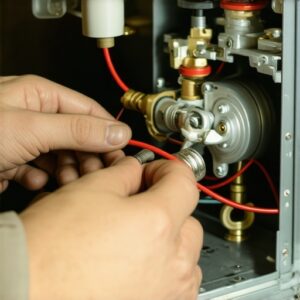
In a North-zone climate, like a Chicago or Northeast winter, the air is dry and the load on the furnace is relentless. When we talk about choosing the best heating service, you need a tech who understands the Seebeck effect. A thermocouple isn’t just a wire; it’s two dissimilar metals joined at the tip that produce a tiny millivolt signal when heated by the pilot light. That signal tells the gas valve it’s safe to stay open. If that tip is oxidized—or if the flame is dancing away from it because of poor combustion analysis—the valve slams shut. It’s a safety feature that keeps your house from becoming a bomb, but it’s also the reason you’re shivering at midnight.
The ‘Sales Tech’ Trap and Real Furnace Ignition Repair
I’ve followed behind too many ‘Sales Techs’ who see a dirty flame sensor and immediately quote $12,000 for a new Energy Star heating certification unit. They’ll tell you the ‘juice’ is leaking or the ‘secondary is shot’ without even pulling a manometer. Real furnace ignition repair involves checking the microamps on that sensor. If you aren’t pulling at least 2.0 microamps, your ignition module is going to drop the flame. Sometimes, it just needs a bit of steel wool to clean the carbon buildup; other times, the pilot orifice is gummed up with debris. This is why preventative heating maintenance is a requirement, not a suggestion.
Airflow, Static Pressure, and the Latent Heat Lie
Even if the ignition is perfect, the system can fail if the duct cleaning services have been ignored for a decade. Heavy dust creates static pressure, forcing the blower motor to ramp up its RPMs until the bearings start that high-pitched screech. This is especially critical in hospital HVAC zoning, where air changes per hour are a matter of life and death, but the physics is the same in your living room. We use demand-controlled ventilation to ensure we aren’t just heating stagnant air. If the air doesn’t move, the heat exchanger overheats, expands, and eventually cracks. Once that metal splits, you aren’t just looking at a repair; you’re looking at carbon monoxide risks.
The 2025 Transition: Ductless and ERVs
We are seeing a massive shift toward heat pump solutions and ductless mini-split installation. These systems bypass the ‘big furnace’ problems by using inverter-driven compressors that don’t just slam on and off. Combined with energy recovery ventilators (ERVs), we can keep the air fresh without losing all the sensible heat we just paid for. For those looking to upgrade, rebate application assistance is huge right now, as federal credits for high-efficiency gear can offset the higher upfront cost of Energy Star equipment.
“Failure to perform annual combustion analysis on high-efficiency condensing furnaces is a leading cause of premature heat exchanger failure.” – ASHRAE Technical Bulletin
Why HVAC Maintenance Plans Matter
A HVAC maintenance plan isn’t just a way for us to keep the lights on during the shoulder seasons. It’s a forensic audit of your home’s lungs. We check the ‘pookie’ on the plenum to ensure no leaks, we measure the gas pressure, and we verify that the thermocouple is generating the right millivolts. If you’re worried about costs, remember that a midnight emergency call-out fee usually costs more than three years of a maintenance plan. If you have questions or a ‘ghost’ in your system, you can always contact us for a real diagnosis, not a sales pitch. Don’t let a small millivolt drop turn into a frozen pipe disaster.