The Sweet Smell of a Failed Heat Exchanger and the Sales Tech Scam
I remember walking into a split-level in the middle of a January cold snap where the mercury hadn’t topped 10 degrees in a week. The customer, a guy named Miller, was pale and complained of a nagging headache he couldn’t shake. He’d just had a ‘specialist’ out there—one of those ‘Sales Techs’ in a pristine white uniform who doesn’t carry a manifold gauge but has a really shiny tablet. That guy had quoted Miller $14,000 for a full system replacement because of a ‘cracked heat exchanger,’ yet the unit was barely five years old. I went downstairs, pulled the burner door, and didn’t find a crack. What I found was a collapsed chimney liner and a flue pipe installation that looked like it was done by a drunk ‘tin knocker’ on a Friday afternoon. The CO was backing up into the mechanical room, and the ‘Sales Tech’ hadn’t even bothered to look at the venting; he was too busy running a credit check for financing. That’s the reality of this industry. If you aren’t looking at the physics of how air moves, you’re just guessing with people’s lives.
The Physics of the Silent Killer: Why Your Detector is Probably in the Wrong Place
Most folks think Carbon Monoxide (CO) behaves like smoke, rising straight to the ceiling. It doesn’t. CO has a molar mass of 28.0, while air is roughly 28.8. It’s slightly lighter, but for all intents and purposes, it’s neutrally buoyant. It doesn’t float to the top; it mixes. It diffuses. It moves with the convection currents of your home. When we talk about preventative heating maintenance, we aren’t just talking about cleaning a flame sensor; we are talking about ensuring the combustion process is complete and the exhaust is actually leaving the building. In 2026, with tighter home envelopes and high-efficiency equipment, the margin for error has shrunk to nearly zero.
“The presence of carbon monoxide is an indication of incomplete combustion and must be investigated immediately.” – NFPA 54: National Fuel Gas Code
Mistake #1: The ‘Dead Air’ Corner Trap
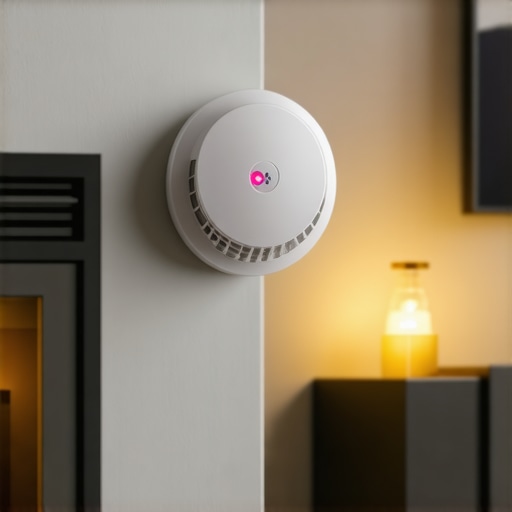
The first mistake I see constantly—usually right after a ‘Sparky’ or a DIY homeowner finishes a renovation—is sticking the CO detector in a corner or right at the apex of a vaulted ceiling. This is what we call a ‘dead air’ zone. Because of the way air flows in a room, it rarely circulates deep into 90-degree corners. If your steam boiler repair fails or a heat exchanger pops a seam, the CO-rich air will bypass those corners as it follows the path of least resistance. You want that detector five feet off the floor, or on the ceiling at least 12 inches away from any wall. If it’s in a dead zone, by the time it trips, you’re already unconscious. We aren’t just installing plastic boxes; we are managing the fluid dynamics of a living space.
Mistake #2: Proximity to the ‘Combustion Zone’ (Nuisance Tripping)
I’ve walked into mechanical rooms where the detector is mounted six inches from the flue pipe. That is idiocy. Every time a gas valve opens and the burners ignite, there is a tiny, infinitesimal ‘puff’ of CO before the draft is established. If the detector is too close, it will trip constantly, leading the homeowner to pull the batteries out in frustration. Now you have a $5,000 boiler and zero protection. You need at least 15 to 20 feet of distance from any fuel-burning appliance. This is especially critical if you have a 24/7 heating emergency response team on speed dial. We need to see real trends, not ‘start-up spikes.’ If you’re dealing with hotel boiler services or large-scale commercial plants, this distance is even more vital to prevent false evacuations.
Mistake #3: Ignoring the Stratification and Bedside Reality
People sleep in bedrooms, not in the hallway. Yet, most building codes only require a detector ‘within the vicinity’ of the sleeping area. If your bedroom door is closed to keep the heat in, and the CO source is a faulty heat pump solution with a supplemental gas furnace backup, that CO is going to fill the hallway while you’re peacefully dreaming. In 2026, I’m pushing for WiFi thermostat integration where the CO detectors talk to the air handler. If a leak is detected, the system should automatically shut down the burners and kick the blower into high gear to dilute the concentration. It’s not just about an alarm; it’s about active mitigation.
“Ventilation air shall be supplied to the space containing fuel-burning appliances in accordance with the manufacturer’s instructions.” – ASHRAE Standard 62.1
The Anatomy of a Heating Emergency: Transformer Replacement and Flue Failures
When I get a call for a ‘no heat’ situation, I’m not just looking for why the light is off. I’m looking for the ‘why’ behind the ‘what.’ A blown transformer replacement is often the result of a shorted contactor or a wire rubbed raw against a vibrating panel. But if that transformer blew because the inducer motor was drawing too many amps trying to push exhaust through a blocked chimney liner, you have a CO disaster waiting to happen. We see this with chimney liner installation more than anything else. Old masonry chimneys crumble; they choke the flue. The heat backs up, the transformer fries, and the ‘Sales Tech’ says you need a new furnace. No, you need a liner and a technician who knows how to read a manometer.
Thermodynamic Zooming: Latent Heat and Combustion Air
In cold climates like the Northeast or Chicago, we deal with extreme sensible heat demands. But we also have to worry about the dew point inside our flue pipes. If the flue gases cool too much before they exit the roof, they condense. That condensate is acidic. It eats through the ‘pookie’ (mastic) and the metal, creating pinhole leaks. This is why flue pipe installation isn’t just about ‘joining pipes.’ It’s about maintaining the temperature of the exhaust to ensure it stays in a gaseous state until it hits the atmosphere. If your air purification integration includes heavy filtration, you might even be creating a negative pressure environment that ‘back-drafts’ the water heater. You can’t just throw parts at a house; you have to balance the pressure.
The 2026 Standard: Occupancy Sensors and Smart Safety
We are seeing a massive shift toward occupancy sensor installation. These aren’t just for lights anymore. Modern HVAC logic uses these sensors to determine where to prioritize airflow. If the system knows you’re in the master bedroom, it can ramp up the VFD (Variable Frequency Drive) to ensure that specific zone is getting the ventilation it needs. When combined with CO monitoring, this becomes a life-saving ‘Airflow Manifesto.’ If you’re looking into financing for heat pump installs, make sure your contractor isn’t skipping the safety peripherals. A ‘cheap’ install is just a slow-motion disaster. Use the right tools, hire a tech who smells like ‘juice’ and knows the sound of a bad bearing, and keep your family breathing. Comfort is physics, and physics doesn’t take days off.