The Sound of a Dying Heat Cycle
You’re sitting on your couch in the middle of a January cold snap, and you hear it: the click-clack of the inducer motor, the roar of the burners, and then—nothing. Just as the house starts to feel human again, the blower shuts down or, worse, keeps running while the air turns ice-cold. You’ve just met the high-limit switch. In my thirty years of crawling through crawlspaces and dragging my tools up to frozen rooftops, I’ve seen this safety device blamed for everything from a bad thermostat to a cursed house. But the truth is simpler and much more technical. The limit switch isn’t your enemy; it’s the only thing keeping your heat exchanger from becoming a molten heap of scrap metal or, God forbid, cracking and venting carbon monoxide into your bedroom.
The Physics Lesson: You Can’t Cool What You Can’t Touch
My old mentor, a grizzled master mechanic named Miller, used to scream at me whenever I’d reach for a multimeter before checking the filters. He’d grab a wrench, bang it against the supply plenum, and yell, ‘You can’t cool what you can’t touch!’ He was talking about the heat exchanger. In a furnace, the burners fire into a metal chamber. That chamber gets red hot. If you don’t move enough cubic feet per minute (CFM) of air over that metal, the heat stays in the steel instead of moving into your living room. When the temperature of that steel hits a specific threshold—usually between 140°F and 180°F depending on the model—the limit switch (a bimetallic disc or probe) snaps open and kills the gas valve. It’s a Thermodynamic Zoom: we’re talking about the transfer of sensible heat from a combustion surface to a moving air stream. If that air stream is weak, the physics fails.
“Equipment shall be sized in accordance with ACCA Manual J, and the duct system shall be designed in accordance with ACCA Manual D to ensure proper airflow across the heat exchanger.” — ACCA Manual S Requirements
The Forensic Diagnosis: Why Your Furnace is Suffocating
When a furnace trips on a high limit, it’s a symptom, not the disease. 90% of the time, the problem is airflow. If you’ve recently upgraded to high-efficiency HEPA filter systems, you might have inadvertently choked your system. Those thick filters have a massive static pressure drop. If your blower motor isn’t designed for that resistance, the air slows down, the heat exchanger overheats, and ‘pop’ goes the limit switch. This is especially common in garage heater installation jobs where the ductwork was an afterthought by some Tin Knocker looking to save a buck on sheet metal. I’ve seen systems where the return air drop was half the size it needed to be. You can’t suck air through a straw and expect a hurricane on the other side.
Another culprit? The evaporator coil. Even if it’s winter, that coil is sitting right in the path of your furnace’s heat. If you haven’t had a tech perform top HVAC repair strategies like cleaning the coil, dust builds up and creates a wall. The air hits that wall, slows down, and the furnace cooks itself. If you’re using voice control setup Alexa Google to ramp up your heat, you’re just asking the system to work harder against a blockage it can’t overcome. It’s like trying to run a marathon while breathing through a sock.
The Mechanical Anatomy: Limit Switches vs. Sensors
Let’s talk about the hardware. A limit switch is a simple device, but in modern hospital HVAC zoning or high-end residential setups, we now see predictive maintenance alerts that can tell us a switch is failing before it actually dies. However, in your standard residential furnace, it’s a physical snap-disc. If your furnace is old and has been short-cycling for years, that bimetallic strip inside the switch gets ‘tired.’ It loses its spring and starts tripping at lower and lower temperatures. This is when a heat pump replacement or a new furnace starts looking like a better investment than throwing parts at a lemon.
“All central heating and air conditioning systems must be maintained to provide a minimum ventilation rate as prescribed by ASHRAE 62.1 to prevent the accumulation of hazardous gases.” — ASHRAE Standard 62.1
The North/Cold Reality: Cracked Heat Exchangers
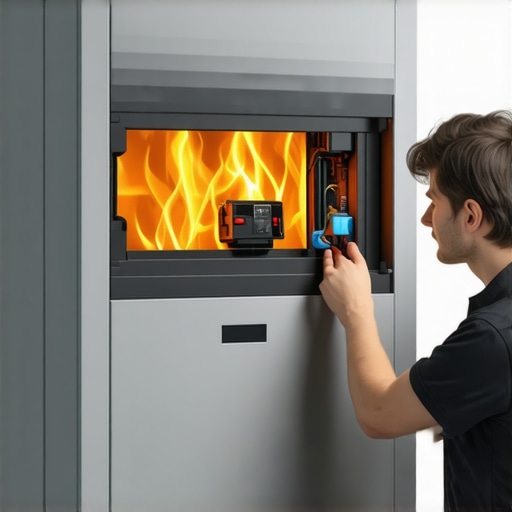
Since we’re dealing with heating in a climate that actually gets cold, we have to talk about Flame Rollout. If your limit switch is tripping, and you smell something slightly metallic or ‘burnt,’ stop. A limit switch that trips repeatedly can cause the heat exchanger to expand and contract too violently, eventually leading to cracks. If those cracks get big enough, the pressure differential between the blower and the combustion chamber can push flames back out toward the burners. That’s a fire hazard and a carbon monoxide death trap. If you find yourself needing emergency heating repair, don’t let a Sales Tech try to sell you a gold-plated system right away, but if the heat exchanger is cracked, the unit is dead. Period.
Repair vs. Replace: The $500 vs. $8,000 Debate
If you’re looking at boiler maintenance services or furnace repairs, you have to weigh the age. A limit switch is a $20 part with a $150-300 labor charge depending on the diagnostic time. But if the reason it tripped is a dead blower motor (the ‘Sparky’ special) or a clogged secondary heat exchanger on a high-efficiency unit, you’re looking at a $1,200 bill. At that point, you’re better off looking into heat pump solutions which are becoming the standard for 2025. Modern electric heater services have come a long way, and heat pumps can now handle the sub-zero temps of a Chicago or Northeast winter without breaking a sweat.
Preventing the Trip: A Veteran’s Advice
How do you stop this? First, quit using those ‘purple’ filters that claim to stop every molecule of dust; they stop the air too. Go for a mid-range pleated filter and change it every 30 days. Second, make sure your registers are open. I’ve seen homeowners close off half the vents in the house thinking they’re ‘saving money,’ but all they’re doing is increasing the static pressure and killing the furnace. Third, get a professional preventative heating maintenance check. A real tech will check the gas pressure and the ‘temperature rise’ to ensure the unit is running within the manufacturer’s spec. If the suction line is ‘beer can cold’ in the summer, your AC is fine, but in the winter, we want that supply air to be a steady, warm breeze, not a blast furnace that shuts off after five minutes.
Don’t fall for the ‘Sales Tech’ scam. If someone tells you that a tripping limit switch means you need a $15,000 system without showing you a cracked heat exchanger or a dead compressor, call someone else. But don’t ignore the switch either. It’s the smoke detector of your furnace’s internal health. Listen to it. Fix the airflow, use some Pookie to seal the duct leaks, and your system will actually last as long as the brochure promised.