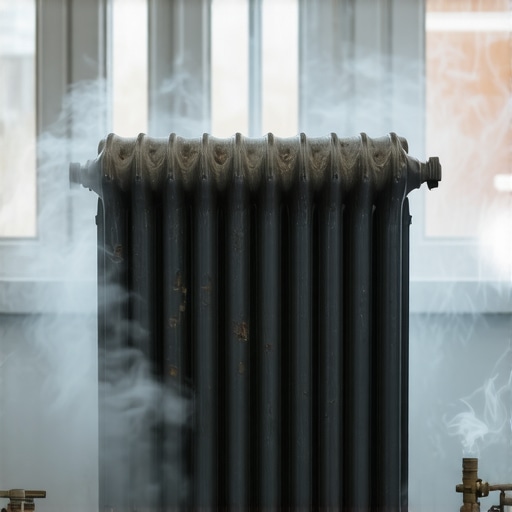
Why Most Schools Overspend on Heating Due to Poor Maintenance
There is a specific kind of silence that hits you when you walk into a three-story middle school at 5:00 AM on a Tuesday in January when the boilers have locked out. It isn’t just quiet; it’s the sound of a looming emergency repair bill and a thousand shivering students. My old mentor used to scream, ‘You can’t heat what you can’t touch!’ This was his way of teaching me that airflow and thermal contact are the two gods of HVAC. Most school districts are bleeding cash not because their units are old, but because they treat boiler maintenance services like an optional suggestion rather than a physical necessity. When you ignore the physics of heat transfer, the equipment works twice as hard to deliver half the results.
“The most expensive equipment in the world cannot overcome a bad duct system.” – Industry Axiom
The Anatomy of a Failing System: A Forensic Diagnosis
Let’s look at the mechanical anatomy of a standard school heating setup. You have the heart—usually a massive boiler or a series of rooftop units (RTUs). Then you have the arteries, which are the ductwork and piping. In a cold climate like the Northeast or Midwest, these systems face brutal thermal stress. If the furnace filter replacement schedule is ignored, the static pressure in the system skyrockets. This is where the ‘Tin Knocker’ (our term for duct specialists) earns his money. High static pressure is like trying to breathe through a cocktail straw while running a marathon. It kills the blower motor, causes the heat exchanger to overheat, and eventually leads to a cracked core. I’ve seen furnace repair services that cost $4,000 for a simple inducer motor failure that was entirely caused by a $20 filter being left in place for two years.
For the administrative wings or newer additions, we often see dual fuel heat pump systems. These are brilliant pieces of engineering that use an electric heat pump for mild days and a gas furnace for the deep freeze. However, without top hvac repair strategies to extend your systems life, these systems lose their efficiency advantage. If the outdoor coil is clogged with cottonwood seeds or debris, the inverter-driven compressors have to ramp up to maximum hertz just to maintain a basic setpoint. You aren’t just paying for the heat; you’re paying for the struggle. We call the refrigerant ‘juice’ or ‘gas,’ and if you’re losing it, you have a leak. Period. Anyone who tells you that a system ‘needs a top-off’ every year is a ‘Sales Tech’ trying to mask a problem rather than fixing the silver-soldered joint that’s vibrating apart.
The Math of the Modern School District
When a school board looks at the budget, they see the high cost of SEER2 compliant upgrades and panic. But they don’t see the latent cost of the status quo. For example, failing to invest in attic insulation for heating in the older buildings means that 30% of the BTUs generated by those expensive boilers are heading straight into the atmosphere. It’s like buying a gallon of milk and pouring three glasses directly down the drain. Then there are the peripheral buildings—the bus garages and maintenance sheds. Often, these areas are served by outdated shop heater services or warehouse heating solutions that haven’t been touched since the 1990s. These are usually standing pilot light units with 60% AFUE (Annual Fuel Utilization Efficiency). That means 40 cents of every dollar goes out the flue pipe.
“Equipment shall be sized to meet the calculated loads… oversizing is a primary cause of inefficiency and equipment failure.” – ACCA Manual J
I recently followed a ‘Sales Tech’ who quoted a local district $250,000 to replace a chiller and boiler plant. I walked the lines and found that the ‘Pookie’ (mastic sealant) on the main return plenum had dried out and cracked, sucking in unconditioned 20°F air from the crawlspace. The ‘Sparky’ (electrician) had also missed a loose neutral wire that was causing the control board to reset every hour. A few buckets of mastic, a screwdriver, and a proper boiler maintenance services visit saved them a quarter of a million dollars. That is the difference between sales and service.
Thermodynamic Zooming: Why AFUE Matters
To understand why the bill is so high, we have to look at the combustion process. In a high-efficiency furnace or boiler, we are squeezing every bit of latent heat out of the exhaust gases. We use secondary heat exchangers to drop the flue temperature so low that the water vapor condenses. If your maintenance crew isn’t cleaning those condensate traps, the acidic water backs up and eats the secondary coil from the inside out. This is why preventative heating maintenance a guide for homeowners in 2025 is just as applicable to a school facility manager. You have to keep the drainage clear or the system will literally digest itself. We see this often when schools attempt to integrate voice control setup Alexa Google or complex Building Automation Systems (BAS) without fixing the underlying mechanical issues. You can have the smartest thermostat in the world, but if your heat exchanger is coated in a 1/8th inch layer of soot, the physics won’t change. You are insulating the fire from the air it’s supposed to heat.
The 2025 Regulatory Cliff
Schools also need to be aware of the shift in refrigerants. We are moving away from R-410A to A2L refrigerants like R-454B. This transition makes choosing the best heating service expert tips for 2025 more critical than ever. The new units require specialized leak sensors and different brazing techniques. If your ‘maintenance guy’ is still using a torch like it’s 1985 without nitrogen purging, he’s going to oxidize the inside of those lines and kill the compressor in three years. For schools looking at long-term savings, heat pump solutions for efficient home comfort in 2025 and institutional upgrades now focus on variable refrigerant flow (VRF) which allows one room to be in cooling while another is in heating, moving energy around the building instead of just creating it from scratch.