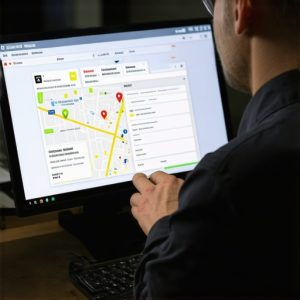
Why Monitoring Your Local Map Position Is the Fastest Way to Spot a Lead Drop
It’s a Tuesday morning, and the service board at your HVAC shop is uncharacteristically empty. You check your website traffic – it looks stable. You check your Facebook ads – they are still running. You ask your office manager if the phones are down, but the line is clear. This is the “Silent Killer” of local businesses: the invisible lead drop. While your traditional metrics might look healthy, your digital storefront has been moved to the back alley of the internet.
As a Google Business Profile Product Expert and Local SEO Consultant, I have seen this scenario play out hundreds of times. Business owners often treat their map ranking as a “vanity metric” – something that is nice to have but not essential for survival. This is a dangerous misconception. In the world of local services, your google business profile seo is the single most important predictor of your bank balance. If you aren’t in the Top 3, you are effectively closed for business.
In this guide, I’m going to break down why tracking your Google Maps position is the only early-warning system that matters, the technical math behind why the “Map Pack” dominates your revenue, and how you can spot a ranking crash before it becomes a financial crisis.
The Math of the Map Pack: Why Position #4 is a Death Sentence
To understand why a drop in rank equals a drop in leads, we have to look at the hard data. Google’s “Local Pack” (the three businesses shown on the main search results page) is the most valuable real estate on the web. According to industry research, businesses that successfully secure a spot in the Google 3-pack receive 126% more traffic and 93% more conversion-oriented actions (calls, direction requests, website clicks) than those sitting just outside of it.
The Click-Through Rate (CTR) curve for local search is incredibly steep. My data shows that the #1 position in the Map Pack captures an average CTR of 17.6%. Position #2 sits at 15.4%, and position #3 at 15.1%. Combined, these top three spots capture 44% of all clicks for a given search query. However, the moment you drop to position #4 – which requires the user to click “More Places” – your visibility falls off a cliff. Most users never make that extra click.
This is the real reason your HVAC business isn’t getting clicks from local maps. Visibility does not equal rank. You can be “visible” at position #10, but in the eyes of a homeowner with a leaking water heater or a broken AC in July, you don’t exist. They are looking for the fastest, most credible solution, and Google’s Top 3 are the only ones who get the call.
Why Map Drops are “Invisible” Until It’s Too Late
One of the biggest mistakes small business owners make is checking their own rankings from their office computer. This is known as “proximity bias.” Because you are physically located at your place of business, Google will almost always show you in the Top 3. However, a customer five miles away might see you at position #12.
This is why using a professional google maps rank tracker is non-negotiable. You need to see the map through the eyes of your customers across your entire service area. If you wait until the phones stop ringing to check your rank, you are already three days behind the problem.
The Algorithm Response Window: T+1 to T+3
Google’s local algorithm doesn’t work in real-time, but it moves faster than traditional organic SEO. We look at the “Algorithm Response Window” in three stages:
- T+1 (24 Hours): Google notices a shift in signals – perhaps a competitor gained five new 5-star reviews or your website had a technical error. Initial movement begins.
- T+2 (48 Hours): Peak response. This is when your ranking usually takes its biggest hit.
- T+3 (72 Hours): The change is incorporated into Google’s rolling evaluation. At this point, the lead drop is fully realized.
If you aren’t monitoring your position daily, you miss the T+1 warning sign. By the time you hit T+3, you’ve already lost three days of potential emergency service calls.
The Concept of “Engagement Thresholds”
Google maintains implicit engagement thresholds for every rank. If you are sitting at Position #1, Google expects a certain percentage of people to click your “Call” button or request directions. If your engagement drops below that threshold – perhaps because a competitor has a more compelling offer or better review snippets – Google assumes you are no longer the best result for that user. They will swap you out for a business that “earns” the clicks. This is a technical feedback loop that can demote you even if you haven’t changed a single thing on your profile.
The 5 Main Reasons Your Position (and Leads) Just Tanked
When you spot a drop in your local seo tools, it usually boils down to one of five factors. Identifying which one is causing the bleed is the first step to recovery.
1. Proximity & Service Area Issues
Google is obsessed with proximity. If a competitor opens a new “verified” location closer to a high-density neighborhood, you might find that your HVAC shop disappears from Google Maps the moment you leave the city center. This is often due to “centroid” shifts in the algorithm where Google prioritizes physical closeness over brand authority.
2. Review Velocity & Sentiment
It’s not just about your total review count; it’s about your velocity. If your competitors are getting three reviews a week and you haven’t had one in a month, your “freshness” score drops. Furthermore, Google’s AI reads the text of your reviews. If customers aren’t mentioning specific services like “AC repair” or “furnace installation,” you lose the semantic relevance needed to rank for those specific keywords.
3. Competitor Aggression
The local map is a zero-sum game. For you to move up, someone else must move down. Competitors may be investing in a google maps ranking service to optimize their secondary categories, add high-quality geo-tagged photos, or build local citations that bridge the gap between their business and yours.
4. Organic SEO Correlation
Your Google Business Profile does not live in a vacuum. There is a high correlation between your website’s organic authority and your map rank. If your website loses its ranking for “HVAC contractor [City],” your map position will almost certainly follow. This is why your HVAC shop is still missing from the local map pack top 3 despite having great reviews – your underlying website authority might be weak.
5. Technical GBP Errors
Sometimes the drop is self-inflicted. A change in your phone number, an unverified edit from a “helpful” user, or a bug in your category selection can tank your rankings overnight. You must stay on top of 5 Google Business Profile fixes that turn map views into emergency repair calls to ensure your technical foundation is rock solid.
How to Diagnose and Fix a Ranking Drop
If you’ve identified a drop in your leads, follow this expert protocol to diagnose the issue and regain your Top 3 status.
Step 1: Confirm the Drop with Grid Tracking
Don’t rely on a single search. Use a tool to check your rank across a 5×5 or 10×10 mile grid. This will show you if the drop is global (affecting your whole area) or local (only affecting certain neighborhoods). Global drops usually indicate a technical penalty or a major algorithm update, while local drops usually indicate competitor movement.
Step 2: Check for “Ghost” Updates
Google often “suggests” edits to your profile based on third-party data or user feedback. If Google changed your primary category from “HVAC Contractor” to “Air Conditioning Repair Service” without you noticing, you might have lost rankings for half of your core keywords. Always audit your dashboard for pending or auto-applied changes.
Step 3: Analyze Competitor Review Velocity
Look at the businesses that jumped over you. How many reviews did they get in the last 30 days? What keywords are appearing in their reviews? If they are out-performing you on “Review Freshness,” you need to implement an automated review acquisition strategy immediately. You can find more tips on this in 7 fast moves to help your heat pump service rank higher on Google Maps.
Step 4: Execute a Proactive Audit
Use google business profile optimization techniques to refresh your profile. This includes:
- Adding 5-10 new high-resolution, geo-tagged photos.
- Updating your “Services” menu with detailed descriptions.
- Posting a “Google Update” (formerly GMB Post) at least twice a week to show activity.
- Ensuring your NAP (Name, Address, Phone) data is consistent across the web.
Refer to the simple checklist to ensure your HVAC shop dominates local search for a full technical breakdown.
The Financial Necessity of Map Tracking
Many business owners view SEO as an expense. I want you to view it as insurance. When you monitor your local map position, you are monitoring the health of your lead pipeline. 68% of consumers are more likely to visit a business that appears in the Map Pack. If you lose that position, you aren’t just losing a “rank”; you are losing 68% of your potential customer base.
The “Silent Killer” doesn’t have to take down your business. By understanding the T+1 to T+3 response window and keeping a close eye on your engagement thresholds, you can pivot before the lead drop hits your bank account. Remember, why most local HVAC listings fail to convert searchers into customers is often a matter of neglect. They assume that once they are ranked, they will stay ranked. In the hyper-competitive HVAC industry, that is never the case.
Conclusion: Don’t Wait for the Phone to Stop Ringing
Monitoring your map position is the only way to predict a lead drop before it happens. In my years as a Google Business Profile Product Expert, I have seen that the most successful companies are the ones that treat their local seo tools with the same respect they treat their accounting software. They know that a red dot on a ranking map today means a red line on a profit-and-loss statement tomorrow.
If you are currently outside the Top 3, or if you’ve noticed a steady decline in your call volume, the time to act is now. Don’t let your competitors capture that 44% of clicks while you sit on page two. Start by auditing your profile, checking your grid rankings, and investing in professional google business profile seo to ensure your business remains the first choice for local customers.
The local map is shifting every single day. Are you watching, or are you waiting for the silence to tell you there’s a problem?