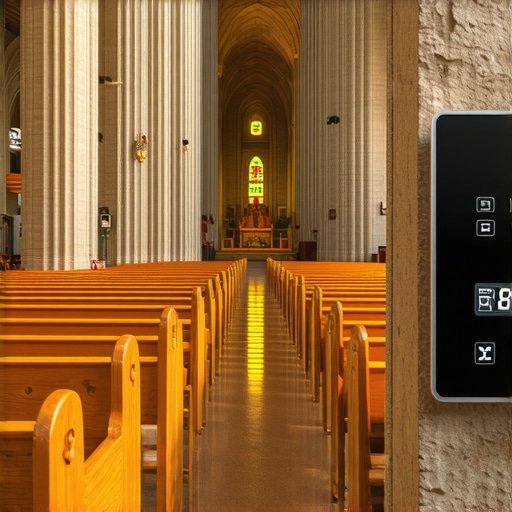
The Thermodynamic Nightmare of the Great Sanctuary
I remember my old mentor, a man who had more soot in his lungs than a 1970s oil furnace, screaming at me in the middle of a cavernous cathedral in mid-January. My ears were ringing from the echo of the massive burners firing up, but his voice cut through: ‘You can’t heat what you can’t touch, kid! This ain’t about horsepower; it’s about where the air goes!’ He was right then, and he’s right now. Most large churches are managed by well-meaning committees who think that if the sanctuary is cold, you just need a bigger furnace. That is a lie peddled by ‘Sales Techs’ who just want to sell you a 20-ton unit when your duct design services are actually what’s failing you. In a church, you aren’t just heating a building; you are fighting the physics of a giant stone or brick box that wants to swallow Btus for breakfast. When you have a sanctuary with 40-foot ceilings and a basement fellowship hall that stays empty six days a week, trying to heat it all with one thermostat is like trying to fill a swimming pool with a squirt gun.
“The most expensive equipment in the world cannot overcome a bad duct system.” – Industry Axiom
In the cold North, we deal with sensible heat and the brutal reality of stratification. Heat rises, and in a church, it’s hanging out in the rafters with the dust bunnies while the congregation’s feet are freezing. This is where demand-controlled ventilation and zone controls become the difference between a sustainable ministry and a utility bill that forces you to sell the organ. We aren’t just ‘blowing hot air’ here; we are talking about the fluid dynamics of air as it moves through the air handler repair cycle. If you don’t have dampers and a sophisticated control board, you are heating thousands of cubic feet of empty air just to get a little bit of warmth into the three pews that are actually occupied during a Wednesday night prayer meeting.
The Physics of Zone Control and Duct Design
When I look at a massive building, I see a series of thermal envelopes. A church has the Sanctuary (the high-ceiling beast), the Classrooms (the low-ceiling rapid-heat zones), and the Offices (the constant-load zones). Without zone controls, your air handler repair costs will skyrocket because the system is constantly short-cycling or, worse, dead-heading against closed registers. A proper duct design services plan ensures that static pressure remains constant regardless of which zone is calling for heat. If you just slap some ‘Pookie’ (mastic) on a leak and hope for the best, you’re ignoring the ‘Tin Knocker’s’ golden rule: air follows the path of least resistance. We use zone dampers to force that air where it’s needed. This is where app-controlled heating systems come into play. A facility manager can now look at their phone and see that the nursery is 68 degrees while the main hall is set to 55 for the weekdays, preventing the burners from firing unnecessarily and eating up the budget.
The Modern Solution: Dual Fuel and Hyper-Heat
For many of these older structures, we are moving away from the old-school ‘big iron’ boilers and furnaces. I’m seeing a massive shift toward dual fuel heat pump systems. This is the ‘Swiss Army Knife’ of HVAC. You have an electric heat pump that handles the moderate cold, and when the temperature drops into the single digits—what we call the ‘Polar Vortex’ zone—the gas furnace kicks in to provide that high-intensity sensible heat. For those add-on wings or the choir rooms that never seem to get enough air, a ductless mini-split installation is the only way to go. These systems use hyper-heat heat pumps that can pull heat out of the air even when it’s -13°F outside. It sounds like magic, but it’s just the refrigeration cycle running in reverse, compressing the ‘gas’ (refrigerant) until it’s hot enough to cook an egg, then blowing that heat into the room. If you’re still relying on an old atmospheric furnace, you’re likely losing 30% of your heat right up the flue, which is why a chimney liner installation and a move to high-efficiency dual fuel heat pump systems are essential for 2025. You can learn more about heat pump solutions for efficient home comfort in 2025 to see how this technology is scaling up for larger buildings.
“Standard 62.1 requires ventilation for acceptable indoor air quality, particularly in high-occupancy spaces like houses of worship.” – ASHRAE Standards
The Hidden Killers: Moisture and Maintenance
One thing people forget about heating a large church is the humidity—or the lack of it. In the winter, the air gets dry enough to crack the wood on the pews. I’ve seen 100-year-old mahogany split because some ‘Sparky’ or handyman bypassed the humidifier. A bypass humidifier repair isn’t just about comfort; it’s about preserving the building. Without proper moisture levels, the air feels colder than it actually is, leading people to crank the thermostat even higher. It’s a vicious cycle. Furthermore, if you’re running older gas equipment, you better be checking that thermocouple replacement and your heat exchanger. A cracked heat exchanger in a building with 500 people is a mass-casualty event waiting to happen due to carbon monoxide. This is why preventative heating maintenance is non-negotiable. You can’t just ‘set it and forget it’ with these large-scale systems. You need a tech who knows how to look for the ‘slugged’ compressor or the ‘acidic’ smell of a burning motor before it dies on Christmas Eve.
Conclusion: Stop Heating Empty Space
The bottom line is that comfort in a large church is a game of physics, not just a game of ‘turning it up.’ Between demand-controlled ventilation that adjusts based on how many people are in the room and app-controlled heating systems that allow for precision scheduling, there is no reason for a church to be wasting money. If your current service provider hasn’t mentioned static pressure or duct design services, they are just ‘parts changers.’ Real HVAC pros know that the ‘Suction Line’ needs to be handled with care and that ‘Juice’ (refrigerant) is a tool, not a band-aid. If your system is struggling, don’t wait for the first frost. Check out top HVAC repair strategies to extend your system’s life and get ahead of the curve. Whether it’s a ductless mini-split installation for the parsonage or a complete overhaul of the air handler repair protocols in the main wing, the goal is always the same: efficient, reliable warmth that doesn’t break the bank.