The Cold Hard Truth About Heating in the North
I have spent three decades crawling through frozen crawlspaces and wrestling with frozen heat pumps in the dead of January, and I am going to tell you something your average ‘Sales Tech’ won’t. Most standard heat pumps are nothing more than expensive paperweights once the temperature hits 20°F. They lose their capacity to move heat because the physics of the refrigerant cycle simply gives up. If you are living in a climate where the wind howls and the mercury vanishes, you don’t need a standard unit; you need a machine designed for the thermal abyss. You need hyper-heat technology. This isn’t marketing fluff. This is about avoiding a 2 AM emergency heating repair call when your compressor slugs because the ‘gas’ is too thin to move. My old mentor used to scream at me while we were shivering on a job site, ‘You can’t cool what you can’t touch, and you can’t heat with a ghost! Flow is everything!’ He was right. If the refrigerant isn’t dense enough to carry the BTU load from the outdoor air, you are just spinning your meter for nothing. This is why we are seeing a massive shift in how we approach heat pump solutions in 2025.
“The most expensive equipment in the world cannot overcome a bad duct system, nor can it violate the laws of thermodynamics in sub-zero conditions.” – Industry Axiom
The Physics of the Freeze: Why Standard Units Fail
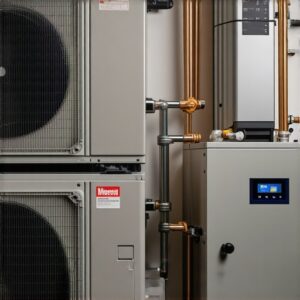
To understand why hyper-heat is the only real answer, we have to look at the ‘Suction Line’ and the state of the refrigerant. In a standard heat pump, as the outdoor temperature drops, the pressure of the refrigerant in the outdoor coil also drops. When that pressure hits a certain floor, the compressor has to work twice as hard to compress a fraction of the mass. It is like trying to breathe through a cocktail straw while running a marathon. Hyper-heat systems solve this using an inverter-driven compressor and a flash injection circuit. Instead of just trying to squeeze the life out of a low-pressure vapor, the system injects a pre-heated, mid-pressure liquid/vapor mixture directly into the compressor scrolls. This allows the system to maintain 100% heating capacity down to 5°F and even keep running at -13°F. Without this, you’re stuck relying on expensive electric heat strips—basically a giant toaster in your ductwork that will triple your utility bill. This is why heat pump solutions for efficient home comfort in 2025 are focusing so heavily on these cold-climate specialized compressors. If your tech isn’t talking about flash injection, he’s just trying to sell you a box, not a solution.
The Regulatory Cliff: R-410A is Dead
We are currently standing at the edge of the ‘Regulatory Cliff.’ As of 2025, the industry is transitioning away from R-410A refrigerant toward A2L refrigerants like R-454B. Why does this matter to you? Because the old ‘Juice’ is getting expensive, and the new systems are being designed with more sensors and safety protocols because A2L is ‘mildly flammable.’ If you are looking at a gas line installation for furnaces or a new heat pump, you need to know that the complexity is going up. This is why choosing the best heating service expert is more critical than ever. You don’t want a ‘Sparky’ or a ‘Tin Knocker’ who hasn’t been certified in A2L handling touching your new $12,000 system. The new boards are sensitive, and if your tech doesn’t understand the electronic expansion valve (EEV) logic, they’ll just tell you that you need a new board when all it needs is a sensor calibration.
The Airflow Manifesto: Ductwork and Static Pressure
I don’t care if you have the fanciest Hyper-Heat inverter on the block; if your ductwork is sized by a ‘Sales Tech’ who used a ‘rule of thumb’ instead of Manual D, you are going to be miserable. I’ve seen 5-ton units strangled by 3-ton ductwork. The static pressure goes through the roof, the motor burns out, and the homeowner blames the brand. We use ‘Pookie’ (mastic) on every joint for a reason. Tape fails; pookie is forever. Airflow is the lifeblood of the system. This is especially true when you start adding energy recovery ventilators (ERVs) or zoning system installation. An ERV is vital in cold climates because you can’t open your windows in January, but you still need fresh air. The ERV swaps the heat from the stale outgoing air to the fresh incoming air, keeping your ‘Latent Heat’ and ‘Sensible Heat’ in balance. If you don’t have proper ventilation, your indoor air quality will tank, and your home will smell like a locker room by mid-February.
Maintenance and the ‘Scam’ Tune-Up
Every fall, I see the mailers: ‘$49 Furnace Tune-Up!’ Stay away from them. Those are just leads for Sales Techs to get in your door and tell you that your heat exchanger is cracked when it’s just a bit of dust. Real preventative heating maintenance involves checking the flame rectification signal (in microamps), measuring the temperature rise across the coil, and checking the static pressure of the blower. It also involves the ‘boring’ stuff like dryer vent cleaning. Do you know how many house fires start because a dryer vent is backed up with lint? It also increases the humidity in the house, which can mess with your thermostat’s geofencing temperature control. A smart thermostat thinks it’s 72°F, but because of the humidity from the clogged dryer, you feel like you’re in a swamp.
“Ventilation is not an option; it is a requirement of the building envelope to prevent structural rot and respiratory distress.” – ASHRAE Standard 62.2
Auxiliary Solutions: Shop Heaters and Wood Stoves
Sometimes a central system isn’t enough, or you have a detached workspace. I’ve spent years installing shop heater services and ventless gas heater services for guys who want to work on their trucks in February without their fingers falling off. But you have to be careful. Wood burning stove installation is great for that dry, radiant heat, but if you don’t have proper makeup air, that stove will compete with your furnace for oxygen. I’ve walked into houses where the water heater was back-drafting carbon monoxide because the wood stove was sucking all the air out of the house. That is why we look at the house as a whole machine, not just a collection of appliances. Every time you add a gas line for a furnace or a shop heater, you change the pressure of the ‘envelope.’ If you don’t balance it, you’re asking for trouble.
The Final Diagnosis
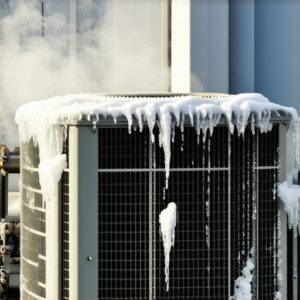
If you are facing a sub-zero winter, don’t let a tech talk you into a standard heat pump with a ‘good’ SEER rating. SEER is for cooling. In the North, you care about HSPF2 (Heating Seasonal Performance Factor). You want Hyper-Heat. You want a system that treats the refrigerant like the precious thermal carrier it is. And for the love of all that is holy, keep your coils clean. A dirty outdoor coil in the winter is a recipe for a solid block of ice. If you see your unit looking like an igloo, don’t take a pickaxe to it. Call for an emergency heating repair and let a pro steam it off. And if you’re ever in doubt about what to do next, check out top HVAC repair strategies to extend your systems life. Staying ahead of the frost is the only way to keep your sanity when the polar vortex hits. If you need a real set of eyes on your system, you can always contact us before the first snowflake falls. Stay warm, keep the static pressure low, and never trust a tech who doesn’t carry a manometer.