The Invisible Grime: Why Your HVAC is Dying Post-Renovation
You finally finished that dream kitchen remodel. The granite is polished, the new backsplash is shimmering, and you’ve swept the floors three dozen times. But every time the blower kicks on, a fine, ghostly mist of white powder settles back onto your counters. You think a quick filter change will fix it? That’s cute. I’ve spent 30 years dragging my bones through crawl spaces and balancing static pressure on systems that were being choked to death by homeowners who didn’t respect the physics of airflow. When you renovate, you aren’t just making dust; you’re creating a lung-clogging cocktail of silica, pulverized gypsum, and sawdust that treats your ductwork like a storage unit. This isn’t about aesthetics; it’s about the fundamental thermodynamics of your home.
The Physics Lesson: You Can’t Cool What You Can’t Touch
My old mentor, a grizzly veteran who could diagnose a bad TXV by the sound of the liquid line, used to scream at me, ‘You can’t cool what you can’t touch!’ He was talking about the heat exchanger and the evaporator coil. If there is a layer of drywall dust acting as a thermal insulator on your fins, the physics of heat transfer simply stop working. This is where most homeowners fall into the trap of thinking they need a gas furnace repair when, in reality, their system is just suffocating. Airflow is the lifeblood of the machine. If the return air is pulling in renovation debris, that dust hits the blower wheel first. A mere 1/16th of an inch of dust on a blower motor’s blades can reduce its efficiency by nearly 30%. You’re paying for 100% of the electricity, but your blower motor replacement clock is ticking twice as fast because the motor is running hotter and harder to move the same mass of air. This is why top hvac repair strategies to extend your systems life always start with the integrity of the air path.
“The most expensive equipment in the world cannot overcome a bad duct system.” – Industry Axiom
The Anatomy of the Renovation Nightmare
When a ‘Tin Knocker’ (that’s ductwork specialist for the uninitiated) installs your system, they design it for specific static pressure. Renovations throw a wrench in that math. Sawdust is heavy and sticky. Drywall dust is fine enough to bypass standard pleated filters. It migrates into the ‘Pookie’—that mastic sealant we use to keep the joints airtight—and starts to degrade the seals from the inside out. If you have crawl space heating solutions, that dust is likely settling into low-lying runs where it will sit and grow mold the moment the humidity spikes. In a Northern climate, where the ‘Polar Vortex’ is a regular guest, your furnace is already under massive stress. Adding a layer of grit to the heat exchanger leads to localized hotspots. These hotspots cause the metal to expand and contract unevenly, eventually leading to a cracked heat exchanger—a death sentence for the unit and a carbon monoxide risk for you.
Why Shop Vacuums and DIY Kits Fail
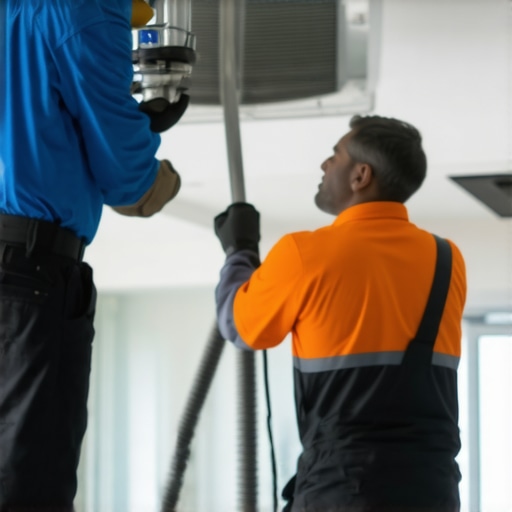
I see it all the time. A homeowner buys a brush kit for their drill and thinks they’re a pro. All they’re doing is loosening the dust so the blower can distribute it more effectively into the coils. Professional duct cleaning isn’t just a vacuum; it’s a surgical procedure involving airflow measurement services and high-vacuum negative pressure. We isolate the system, block off the registers, and pull a vacuum so strong it would make a black hole jealous. While we’re in there, we perform system performance testing to ensure the static pressure is back within the manufacturer’s specs. If your system is old and you’re considering low-GWP refrigerant retrofits to prepare for the 2025 R-454B transition, starting with clean ducts is non-negotiable. New refrigerants operate at different pressures and temperatures; they have zero tolerance for poor airflow.
The Latent Heat Trap: Humidity and Dust
In the North, we deal with the ‘Cold Swamp’ effect if the IAQ (Indoor Air Quality) isn’t managed. Dust acts as a desiccant. It holds onto moisture. If your ducts are dirty, your dehumidification services will struggle because the moisture is trapped in the dust layers inside the dark, cool sections of your ducting. This becomes a breeding ground for biological growth. This is exactly why preventative heating maintenance a guide for homeowners in 2025 emphasizes the cleaning of the secondary heat exchanger and the blower housing. If you’re installing whole-home humidifiers, you’re basically just adding water to a dust-mud mixture in your vents if you haven’t cleaned them post-reno. It’s disgusting, and it’s avoidable.
“Ventilation systems shall be designed to prevent the accumulation of moisture and particulate matter that could lead to microbial growth.” – ASHRAE Standard 62.2
The Service Tech’s Warning: Don’t Be a Victim of the ‘Sales Tech’
I hate Sales Techs. You know the ones—they show up in a clean uniform, spend five minutes looking at your furnace, and tell you that you need a $15,000 unit because your ‘gas is low.’ If a tech doesn’t check your static pressure or look inside your blower cabinet after a renovation, they aren’t a tech; they’re a predator. If you’re smelling something ‘sour’ when the heat kicks on, it could be a refrigerant leak detection issue or it could be dust burning off the heat strips in your air handler. If it’s the latter, a cleaning saves you a fortune. If you have shop heater services in your garage where you were doing the actual wood cutting, that unit is likely even worse off. The combustion air intake on those units can pull in sawdust and create a literal fire hazard.
The Final Word on Post-Renovation Airflow
At the end of the day, comfort is physics. It isn’t magic. If your ‘Suction Line’ isn’t beer-can cold and your ‘Liquid Line’ isn’t warm to the touch, something is wrong with the energy transfer. Most of the time, that ‘something’ is the pound of drywall dust sitting in your return plenum. Before you sign a contract for a new system, get a professional airflow audit. Clean those ducts, seal the leaks with real ‘Pookie,’ and ensure your system can actually breathe. If you need a pro who knows the difference between a micron gauge and a manifold, contact us today. We don’t do ‘sales pitches’; we do science. For more on modern comfort, check out heat pump solutions for efficient home comfort in 2025 or see our choosing the best heating service expert tips for 2025. Don’t let your renovation dust turn your HVAC system into an expensive paperweight. Clean the air, save the motor, and finally breathe easy in that new kitchen.