The Morning the Heat Died: A Forensic Look at Commercial Comfort
There is a specific sound that a commercial mechanical room makes when it’s about to eat your quarterly profit margin. It’s not a bang; it’s a rhythmic, metallic screech that sounds like a banshee in a tin can. As someone who has spent thirty years dragging manifolds through crawlspaces and standing on frozen rooftops in the dead of winter, I can tell you that silence is the most expensive sound in business. Last winter, I followed a ‘Sales Tech’—one of those guys with a clean uniform and a clipboard who couldn’t tell a capacitor from a tuna sandwich—into a local retail shop. He had quoted the owner $18,000 for a full RTU replacement because of a ‘burned out heat exchanger.’ I climbed up there, pulled the panel, and found a flame sensor so caked in oxidation it looked like a prehistoric fossil. Ten minutes of cleaning and a $50 service call saved that owner from a commission-hungry shark. That’s the difference between real shop heater services and a sales pitch.
The Physics of Failure: Why 2026 is Different
By 2026, the industry has shifted. We aren’t just looking at basic fire-and-fan boxes anymore. We are dealing with smart building management systems that monitor every CFM and static pressure variance in real-time. If your system is failing, it’s not just ‘getting old’; it’s usually a victim of thermodynamic neglect.
“The most expensive equipment in the world cannot overcome a bad duct system.” – Industry Axiom
When we talk about variable speed furnace services, we’re talking about the ability to manage sensible heat without overshooting the setpoint. In a North/Cold climate, the enemy is thermal fatigue. Every time your furnace cycles on, that heat exchanger expands. Every time it shuts off, it contracts. Do that 10,000 times a season because of an oversized unit, and you’ll get a crack that leaks carbon monoxide faster than you can call for 24/7 heating emergency response.
Sign 1: The Temperature Stratification Trap
If the front office is a sauna while the warehouse feels like a meat locker, you don’t have a thermostat problem; you have a static pressure problem. This is where ‘tin knockers’ earn their keep. In 2026, many businesses are integrating heat recovery ventilators (HRV) to meet new indoor air quality standards. If your HRV is fighting your furnace, you’re literally burning ‘juice’ (refrigerant or gas) to heat air you’re throwing out the window. Proper annual heating inspection routines check the balance between these systems. If you’re feeling cold spots, your blower motor might be losing its torque, or your ductwork might be leaking air into the attic because the ‘Pookie’ (mastic) has finally dried out and cracked after twenty years of service.
Sign 2: The Combustion Color Code
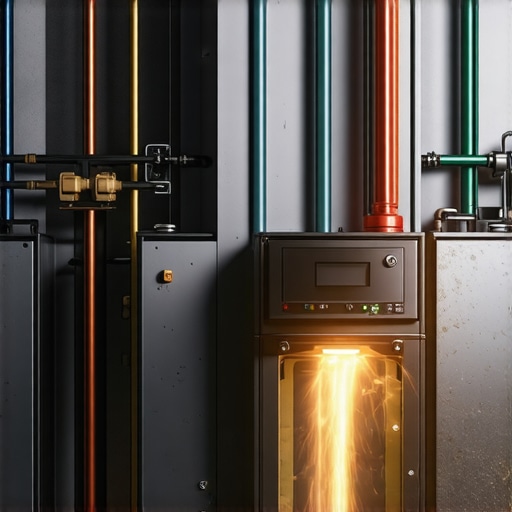
You need to look at your flame. I don’t care if you’re using propane conversion services or standard natural gas; the physics of combustion don’t lie. A healthy flame is crisp and blue. If you see lazy, yellow flickering, you’re looking at incomplete combustion. That yellow is carbon—unburnt fuel—and it’s a sign that your heat exchanger is choked or your gas pressure is off. This is a primary reason to check your warranty service plans before the winter hit.
“Standard 90.1 sets the minimum energy performance for commercial buildings.” – ASHRAE
If your combustion efficiency drops, your flue gas temperatures skyrocket. You’re essentially heating the sky while your employees shiver. This is also why portable heater safety checks are a red flag; if your staff is plugging in space heaters, your main plant is already dead in the water.
Sign 3: The Ghost in the Smart Controls
Modern smart building management is a double-edged sword. It provides data, but it also provides complexity. If your furnace is ‘hunting’—constantly ramping up and down without reaching a steady state—your variable speed drive or the sensors are failing. This ‘short cycling’ is a silent killer. It ruins the ‘gas’ (refrigerant) oil in heat pump systems and fries contactors in furnaces. If you’ve recently transitioned to geothermal heat pump systems, this is even more critical, as the loop temperatures must stay within specific parameters to prevent compressor slugging. You can find more about high-level fixes in our guide on top HVAC repair strategies.
Sign 4: The Escalating Utility Bill
If your gas bill in 2026 looks like a phone number, your AFUE (Annual Fuel Utilization Efficiency) rating has likely tanked due to internal fouling. Dust on the secondary heat exchanger acts as an insulator. Instead of the heat moving into the air stream, it stays in the metal, causing the high-limit switch to trip. This is why preventative heating maintenance is the only way to keep those costs down. A technician who knows his stuff will check the ‘Delta-T’—the temperature rise across the heat exchanger. If it’s out of spec, you’re wasting money. If you’re still deciding on the right partner for this, check out these expert tips for 2025 and 2026. Don’t let a ‘Sales Tech’ tell you that you need a new $30,000 system when a proper cleaning of the burners and a calibration of the manifold pressure would give you another five years of life. Real HVAC work is about physics, not commissions. If you’re smelling something sour or hearing that screech, it’s time to contact us before the freeze sets in for good. “,