The Eerie Silence of a Dead Zone
There is a specific kind of silence that happens at 3:00 AM in the middle of a February freeze. It is not the peaceful silence of a sleeping house; it is the heavy, oppressive silence of a heating system that has given up the ghost. As a technician who has spent three decades crawling through frozen crawlspaces and troubleshooting ‘no-heat’ calls while my own breath clouded the air, I can tell you that baseboard heaters are the most misunderstood soldiers in the HVAC army. Whether you are running a hydronic system or electric resistance strips, these units rely on the simplest law of physics: convection. When that stops, your comfort dies. My old mentor, a man who could smell a cracked heat exchanger from the driveway, used to scream at me, ‘You can’t heat what you can’t touch!’ He was talking about airflow. If the air doesn’t move across those fins, the room stays a tomb. Before you panic and search for heating service, let’s perform a forensic diagnosis on your baseboard system.
“Hydronic heating systems must be designed to account for the specific thermal conductivity of the emitters and the flow rate of the medium to ensure even heat distribution.” – ASHRAE Fundamentals Handbook
Most homeowners assume a dead heater means a dead unit, but in the world of hydronic heating systems and electric baseboards, it’s usually a communication breakdown between the ‘brain’ and the ‘muscle.’ We aren’t just looking for a broken part; we are looking for why the energy transfer has stalled. If you have a modulating furnace repair on your mind or are considering wall furnace installation, you first need to understand the basic plumbing or wiring of what you already own. Let’s look at the three most common points of failure that don’t require a $200-an-hour service call.
1. The Transformer and Low-Voltage ‘Brain’ Check
If your heater isn’t even trying to get warm, the issue is likely electrical, but it’s rarely a blown heating element. It is usually the 24V control circuit. Inside your system, or mounted to a nearby junction box, is a transformer. This little cube is the heart of your control system; it steps down your house’s 120V or 240V power to a safe 24V for the thermostat. I have seen ‘Sales Techs’ tell homeowners they need a whole new dual fuel heat pump system when all they really needed was a transformer replacement. To check this, you need a multimeter. If you’re getting power into the transformer but nothing is coming out of the secondary side, you’ve found your culprit. This is a common fix during a heating service call that gets overcharged. Without that 24V signal, your heater is just a piece of decorative metal. If your home uses hyper-heat heat pumps as a secondary source, the transition between the two often fails at this specific low-voltage junction.
2. The ‘Burp’ – Bleeding Air from Hydronic Lines
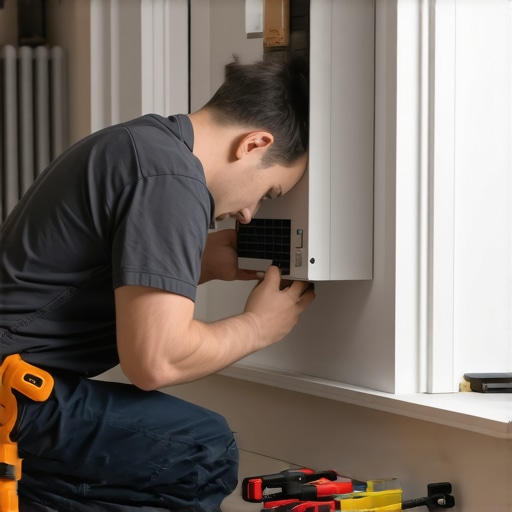
If you have a hydronic system (water-based) and the heater is hot at one end but cold at the other, you have an air lock. Air is a terrible conductor of heat compared to water. In the HVAC trade, we call this ‘air-bound.’ This is especially common if you’ve recently had a pool heater repair or spa heater services performed on a shared boiler system. Air gets trapped in the high points of the loops. To fix this, locate the bleeder valve—usually a small needle-valve on the end of the baseboard unit. You’ll need a ‘radiator key’ or a flathead screwdriver. Hold a rag under it and open it slowly. You’ll hear a hiss—that’s the ‘death rattle’ of the air pocket. Once a steady stream of water comes out, close it. You’ve just restored the thermodynamic loop. If the air keeps coming back, you might have a failing expansion tank or an auto-fill valve issue, but ‘burping’ the system is your first line of defense. This simple physics lesson saves thousands of homeowners from unnecessary hydronic heating systems overhauls.
“Air in a closed-loop hydronic system increases pump wear and significantly reduces the BTUH output of baseboard radiation.” – ACCA Manual J Standards
3. The Convection Killer: Fin Maintenance and Airflow
This is where the ‘Tin Knockers’ and the service techs agree: airflow is king. Baseboard heaters work by drawing cold air from the floor, heating it via the aluminum fins, and letting it rise. If those fins are crushed, covered in pet hair, or blocked by a thick rug, the convection current dies. I’ve walked into ‘broken heater’ calls where the only problem was a layer of dust acting as an insulator. Use a vacuum with a brush attachment to clean the fins. If the fins are bent, use a fin comb (or a steady hand with a flathead) to straighten them. If the air can’t ‘touch’ the hot metal, the room won’t get warm. This same logic applies to blower motor replacement in forced-air systems; if the air doesn’t move, the heat stays trapped in the equipment until it trips a high-limit switch. For those looking into heat pump solutions for efficient home comfort in 2025, remember that even the most advanced dual fuel heat pump systems are useless if your delivery method—the ducting or the baseboards—is neglected.
When the DIY Ends and the Pro Begins
If you’ve checked the transformer, bled the air, and cleaned the fins, and you’re still shivering, the problem might be deeper—like a seized zone valve or a scaled-up boiler heat exchanger. In northern climates, the cold is relentless, and your equipment works harder than anything else you own. For more complex issues like a modulating furnace repair or a wall furnace installation, it pays to consult someone who knows the ‘gas and juice’ inside out. You can find more expert advice on choosing the best heating service expert tips for 2025 or see our top HVAC repair strategies to extend your system’s life. Don’t let a ‘Sales Tech’ talk you into a $15,000 system when a little bit of physics and a $20 part could get you through the night. If you’re truly stuck, you can always contact us for a real diagnosis, not a sales pitch. Protecting your home starts with understanding the machines that keep it alive. Be sure to review our privacy policy for how we handle your service data, and check out our guide on preventative heating maintenance for 2025 to stop the next breakdown before it starts.
I found this article really helpful because we’ve been troubleshooting our baseboard heater for a while now. The reminder about airflow and fin cleanliness was especially eye-opening—I never considered dust buildup could be enough to cause a cold spot. Regular maintenance, like vacuuming the fins and straightening them, can really make a difference and extend the lifespan of the unit. When I had similar issues last winter, I also checked the thermostat wiring, which was fine, but the airflow was blocked by a rug. It’s a good reminder that sometimes, the simplest fixes are overlooked. Has anyone else tried these DIY methods before calling in a professional? I’d love to hear if there are other quick tips for maintaining efficient baseboard heating without costly repairs.