The Dead Silence of a January Midnight
There is a specific kind of silence that wakes an HVAC technician up at 3 AM. It is not the wind or the dog; it is the absence of the inducer motor’s hum. When that gas furnace repair goes from a ‘maybe next week’ to a ‘the basement is now an ice rink,’ you realize thermodynamics does not care about your sleep schedule. My old mentor, a grizzly guy we called Sarge, used to scream at me while I was knee-deep in a frozen crawlspace: ‘You can’t cool what you can’t touch, and you can’t heat what you can’t circulate!’ Sarge was a tin knocker by trade, and he knew that airflow was the literal lifeblood of the home. He taught me that most catastrophic failures are not about the box; they are about the static pressure testing we ignored and the ductwork held together with pookie (mastic) and a prayer. In the North, the enemy is the polar vortex, and the only thing standing between your finished basement and $50,000 in water damage is a tiny 24-volt circuit and your WiFi thermostat integration.
The Anatomy of a Freeze: Why Pipes Burst
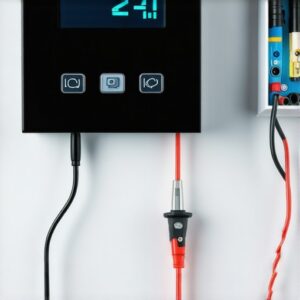
To understand why a WiFi thermostat integration is a literal life-saver, you have to understand the physics of latent heat and water expansion. When your furnace fails—maybe it is a dirty flame sensor or a blown capacitor—the sensible heat in your home starts escaping through every unsealed rim joist and poorly insulated wall. Once the indoor ambient temperature drops below 32°F, the water in your copper or PEX lines begins to undergo a phase change. Unlike almost every other substance, water expands when it freezes. This expansion exerts thousands of pounds of pressure per square inch. The pipe does not usually burst at the ice blockage itself; it bursts from the hydraulic pressure built up between the ice and a closed faucet. [IMAGE_PLACEHOLDER] This is where preventative heating maintenance becomes your first line of defense. By the time you notice the water, the damage is done. A remote access thermostat acts as the ‘check engine light’ for your entire house, sending an alert to your phone the second the temperature dips below a safe threshold, like 45°F, giving you hours to call for a gas furnace repair before the copper starts splitting.
“The most expensive equipment in the world cannot overcome a bad duct system or a lack of monitoring.” – Industry Axiom
The Forensic Diagnosis: Why the Heat Stops
In my 30 years, I have seen ‘Sales Techs’—those guys in clean uniforms who carry iPads and couldn’t tell a manifold gauge from a toaster—try to sell a $15,000 heat pump or furnace when the unit just needed a $150 fix. They see a homeowner in a panic because their pipes are freezing and they pounce. But let’s look at the mechanical anatomy of why your heat actually died. It is often the ‘heart’ or the ‘lungs.’ The heart is the inverter-driven compressor or the burner assembly, and the lungs are the blower motor and the ductwork. If you haven’t had airflow measurement services performed lately, your blower might be struggling against a dirty air purification integration system or a high-MERV filter that is way too restrictive for your return air drop. This causes the heat exchanger to overheat and trip the high-limit switch. The system shuts down for safety, and if you are away on vacation, that is when the freezing begins. Using top hvac repair strategies to extend your systems life means looking at the static pressure testing results to ensure the ‘lungs’ of your home aren’t being strangled.
Smart Tech vs. The Polar Vortex
We are moving into 2025, and choosing the best heating service expert means finding someone who understands WiFi thermostat integration and zoning system installation. In a basement, which is naturally colder, a standard thermostat upstairs might think the house is a cozy 68°F while the basement utility room is hovering at 38°F. By installing remote sensors and a smart hub, you can monitor the ‘micro-climates’ of your home. If the furnace fails, the system detects the rapid heat loss. This is especially critical for those with an infrared heater installation in specific zones or those relying on a heat pump in climates where a backup ‘heat strip’ or gas furnace is required during a freeze. A heat pump is great, but in a Chicago-style winter, you need to know exactly when it has switched to emergency heat or if it has locked out due to ice buildup on the outdoor coil. Monitoring this via an app means you can contact a pro before the ‘juice’ (refrigerant) stops moving and the pipes start groaning.
“Adequate thermal management and continuous monitoring are the primary defenses against structural water damage in sub-zero environments.” – ASHRAE Standards
The Cost of Neglect: Repair vs. Replacement
I always tell my customers: you can pay me now for preventative heating maintenance, or you can pay a restoration company later to rip out your drywall. When we perform IAQ improvement services or a general tune-up, we aren’t just vacuuming out dust. We are checking the ‘Sparky’ (electrician) work on the contactors and ensuring the zoning system installation dampers are actually opening. If your system is over 15 years old and running on an 80% AFUE rating, you might be looking at a ‘cracked heat exchanger’ scenario. This is the ultimate ‘pull the plug’ moment. If we find CO leakage, the unit must be shut down. This is why having a remote alert is vital—if I have to red-tag your furnace in January, you need to know immediately so we can get a new, high-efficiency unit in before the freeze sets in. Don’t let a sales guy scare you into a new unit if your gas furnace repair is just a dirty flame sensor, but don’t ignore the math when your 1990s dinosaur is leaking gas and money. If you need help, contact us for a real diagnosis, not a sales pitch.