The One Missing Step on Your Google Business Profile That Keeps Your Phone Silent
You’ve done everything the “gurus” told you to do. You claimed your listing, verified your address, uploaded a dozen high-resolution photos, and even managed to snag a handful of five-star reviews from your best customers. On the surface, your profile looks perfect. It’s “complete.” Yet, the phone remains stubbornly silent. You check your insights and see the same depressing numbers: a handful of views, even fewer clicks, and zero calls from the high-intent customers in your service area. As a Google Business Profile Product Expert and Local SEO Consultant, I see this scenario play out daily with local businesses and agencies alike. The frustration is real, but the reason behind it is often a single, overlooked technicality.
The problem is that most businesses treat their Google Business Profile (GBP) as a static billboard – a digital yellow pages ad that you set once and forget. However, Google’s algorithm has evolved. For the 2025 and 2026 search landscape, Google has shifted its weight significantly. It no longer just cares about who you say you are; it cares about what you are doing right now. Data from recent core updates suggests that Google is prioritizing “Prominence” and “Hyperlocal Activity” over simple “Relevance.” If you aren’t feeding the algorithm the specific behavioral signals it craves, you are essentially invisible. This post will reveal the one missing step that bridges the gap between being listed and being found.
Why “Complete” Does Not Mean “Optimized”
There is a massive distinction between a profile that is “complete” and one that is truly engaged in google business profile optimization. When you fill out every field in the GBP dashboard, you are merely meeting the minimum entry requirements. You’ve told Google your name, your category, and your hours. But here’s the catch: so has every single one of your competitors. If there are ten HVAC companies in a five-mile radius, and all ten have “complete” profiles, Google needs a tie-breaker to decide who gets the coveted top three spots in the Local Map Pack.
Google’s local ranking algorithm relies on three primary pillars: Relevance, Distance, and Prominence.
- Relevance: How well a local business profile matches what someone is searching for.
- Distance: How far each potential search result is from the location term used in a search.
- Prominence: How well-known a business is, based on information that Google has about a business from across the web.
Most business owners focus on relevance and distance. They think, “I’m an HVAC shop, and I’m located in this city, so I should show up.” But distance is a fixed variable, and relevance is easily copied. Prominence is where the battle is won or lost. If your profile is static, your prominence score plateaus. You might even find that 3 red flags our audit found in HVAC profiles are currently killing your rankings because you’ve relied on a “set it and forget it” strategy that Google now interprets as business inactivity.
The Missing Step Revealed: Hyperlocal Behavioral Signals
The “One Missing Step” that separates the leaders from the laggards is the consistent generation of hyperlocal behavioral signals. Google is no longer satisfied with knowing your service area; it wants proof that you are active within that area. A profile is a living entity. If you aren’t providing evidence of real-world activity, Google assumes your business is less “prominent” than the competitor who is actively posting, updating, and engaging with their local community.
To rank google business profile listings effectively in 2025, you must move beyond the dashboard. This involves a strategy I call “Proof of Presence.” Here is how you execute the missing step:
1. Geo-Contextual Photo Strategy
Stop using stock photos or generic shots of your office interior. To boost your google business profile seo, you need to upload photos taken at job sites within your service area. While Google has become more adept at stripping EXIF data (metadata that includes GPS coordinates), its AI vision can still recognize local landmarks, street signs, and even the specific architectural styles of certain neighborhoods. When you upload a photo of a furnace repair in a specific suburb, you are providing a visual signal of your local relevance. For advanced users, leveraging google business profile seo software can help manage these assets and ensure they are being deployed to maximize visibility.
2. Locally-Optimized Review Responses
Most businesses either don’t respond to reviews or use a generic “Thanks for the business!” template. This is a wasted opportunity. When you respond to a review, you should weave in local keywords and neighborhood names naturally. For example: “It was a pleasure helping you with your AC emergency in the North Hills district!” This signals to Google’s NLP (Natural Language Processing) engines that your business is a pillar of that specific geographic community.
3. GBP Posts as Local Newsletters
Treat your GBP posts not as ads, but as a local news feed. Mention local events you are attending, local landmarks near your current job site, or even weather-specific advice for your city. This creates a “freshness” signal that tells Google your business is operational and highly relevant to the current local context. If you find this manual process tedious, many professionals use local seo tools to automate the scheduling of these localized updates while maintaining a high level of quality.
The Category Trap: Why Your Primary Choice Might Be Killing Your Leads
Another area where the “One Missing Step” often fails is in the technical selection of categories. Many business owners fall into the “Category Trap.” They choose a broad primary category like “Contractor” because they want to cast a wide net. In reality, they are casting a net with holes so big the fish swim right through. To rank higher on google maps, you must be surgical with your primary category selection.
If you are an HVAC specialist, your primary category should be “HVAC Contractor” or “Air Conditioning Repair Service,” not a general “Contractor” tag. Google’s internal data shows that top-ranking profiles in the Map Pack often have 2-3 highly specific secondary categories that support the primary one without “category stuffing.” For instance, an HVAC shop might use:
- Primary: HVAC Contractor
- Secondary: Furnace Repair Service
- Secondary: Air Conditioning Contractor
Adding irrelevant categories – like “Plumber” if you only do 5% plumbing – can actually dilute your relevance for your core services. Google’s algorithm is designed to find the best answer for a specific query. If you try to be the answer for everything, you end up being the answer for nothing. We’ve seen businesses jump from page 3 to the top 3 simply by correcting a mismatched primary category that was confusing the local search engine.
The Review Gap: Beyond Just “Getting Stars”
We all know reviews are important, but the “Missing Step” here is understanding Review Velocity and Review Diversity. In February 2025, Google rolled out an update that significantly increased the filtering of reviews that appeared “unnatural.” Many businesses saw dozens of legitimate reviews vanish overnight. Why? Because their review acquisition didn’t match their real-world business patterns.
Google doesn’t just look for a 5-star rating. In fact, the average rating for a top-3 ranking business is often around 4.4 to 4.8 stars. A perfect 5.0 with 500 reviews can sometimes look suspicious to an algorithm tuned to detect fraud. What Google really wants to see is “Review Velocity” – a steady, consistent stream of feedback rather than a burst of 50 reviews in one week followed by three months of silence.
Furthermore, the content of the review matters more than the stars. You should actively encourage your customers to mention the specific service they received and the location. A review that says, “Kevin fixed my heater in downtown Portland” is worth ten reviews that just say, “Great job.” This helps close the gap and implement the specific moves that push your HVAC shop into the local map pack top 3 by building a keyword-rich profile through user-generated content.
Technical Synergy: Connecting Your Website to Your Map Pin
Your Google Business Profile does not exist in a vacuum. One of the most critical parts of local search optimization is the technical bridge between your GBP and your website. If your website doesn’t reinforce what your GBP says, Google will hesitate to rank you. This is where many “DIY” SEO efforts fail.
Your website needs to be a “Local Authority Hub.” This means implementing Local Business Schema (JSON-LD) that mirrors your GBP information exactly – down to the last comma in your address. If your GBP says “Street” and your website says “St.”, it can create a minor data conflict that affects your prominence score. More importantly, you need dedicated “Geo-pages” or “Service Area Pages” that provide deep, useful content about the specific neighborhoods you serve.
If you’ve ever wondered why your HVAC shop is invisible on Google Maps even when you’re standing in the driveway, it’s often because your website lacks the local authority to support your map pin. You need to ensure that your GBP link points to the most relevant local page, not just the homepage, especially if you have multiple locations. You can follow the Google Maps ranking checklist that actually works to ensure your technical foundation is rock solid before you start worrying about advanced behavioral signals.
Professional Tools for Dominating the Map Pack
At a certain point, manual tracking and optimization become impossible. If you are managing multiple locations or trying to dominate a highly competitive metro area, you need professional-grade google maps ranking service capabilities. You cannot simply search for your business on your own phone and assume that’s what everyone sees. Google personalizes results based on the searcher’s exact coordinates.
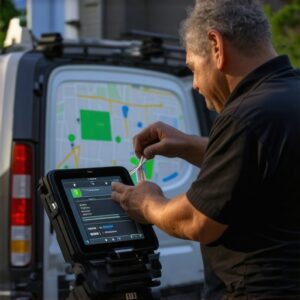
To truly understand your visibility, you must use a **google maps rank tracker**. These tools provide a “grid view” of your rankings, showing exactly where your visibility drops off. You might rank #1 at your office, but drop to #10 just two blocks away. This reveals “dead zones” where you need to focus your hyperlocal activity.
For those serious about scaling their local presence, using local seo software is no longer optional; it is a requirement. These tools allow you to monitor your competitors’ moves, track your review velocity against the market average, and identify the specific “behavioral gaps” that are keeping you out of the Top 3. Whether you are an agency or a savvy business owner, having the right data is the only way to make informed decisions in a volatile search environment.
Conclusion: Turning the Silence Into Ringing Phones
The “One Missing Step” on your Google Business Profile isn’t a secret setting or a hidden button in the dashboard. It is the transition from treating your profile as a static listing to treating it as a dynamic, hyperlocal engagement platform. By focusing on behavioral signals – geo-contextual photos, locally-optimized review responses, and technical synergy with your website – you provide Google with the “Prominence” data it needs to justify putting you at the top of the search results.
Stop waiting for the algorithm to “notice” you. Take control of your local presence today. Audit your categories, fix your review strategy, and start feeding the beast the local data it craves. If you aren’t sure where to start, leverage specialized **GBP ranking tools** to find your visibility gaps and start turning that digital silence into a ringing phone. Your customers are searching for you right now; make sure you’re the one they find.