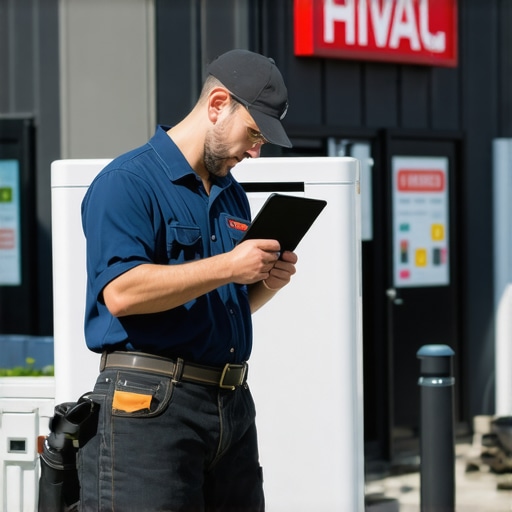
5 Trust Signals That Actually Move Your HVAC Shop Up the Local Map Pack
For many HVAC business owners, the “Google Map Pack” feels like an exclusive club where the membership rules are written in a language only Google understands. You have the trucks, the technicians, and the local reputation, yet when a homeowner searches for “AC repair near me,” your shop is nowhere to be found. This “invisible” status isn’t just frustrating; it’s costing you thousands in lost emergency calls and seasonal maintenance contracts. To win at google business profile seo, you must understand that the algorithm has evolved beyond simple keyword matching.
The Map Pack – the top three local listings that appear at the top of Google’s search results – is the holy grail of local seo for hvac. While proximity (how close you are to the searcher) used to be the primary driver, Google now prioritizes “Trust Signals.” These are specific data points that prove to the algorithm that your business is legitimate, reliable, and highly relevant to the user’s needs. In fact, research from Visual Realm indicates that review signals alone drive approximately 15% of local pack ranking factors. If you find yourself asking why your HVAC shop is still missing from the local Map Pack Top 3, the answer usually lies in a lack of verified trust.
Signal #1: Review Velocity and Sentiment Depth
Most contractors know they need reviews, but few understand the nuance of “Review Velocity.” Google isn’t just looking at your total star rating; it is monitoring how consistently you receive feedback. A sudden burst of 20 reviews followed by three months of silence is a red flag for the algorithm, often suggesting a “review blast” rather than organic customer satisfaction. To rank higher on google maps, you need a steady, predictable stream of incoming sentiment.
According to data from The Blueprint Training, consistent and positive reviews are the #2 most important ranking factor for local SEO. However, the *depth* of the review matters just as much as the frequency. A review that simply says “Great job” provides little “trust data” to Google. Conversely, a review that mentions specific services – such as “fixed my Lennox furnace” or “emergency boiler repair in the middle of the night” – helps Google categorize your business for specific long-tail keywords. This is why implementing a dedicated google review strategy is essential for maintaining momentum.
If you are struggling to maintain this pace, a professional google maps ranking service can help you implement systems that automate the request process, ensuring that every service call ends with a digital footprint. Remember, Google’s AI reads these reviews to understand your service area and expertise. When a customer mentions your technician by name or describes a complex ductwork installation, they are essentially writing your SEO content for you.
Signal #2: Visual Transparency & Geo-Tagged Media
In the world of google business profile optimization, stock photos are the enemy. Google’s Vision AI is incredibly sophisticated; it can distinguish between a generic photo of a condenser unit and a real photo of your branded truck parked in a local driveway. Visual transparency acts as a “Proof of Work” signal that many competitors ignore.
To move the needle, you must focus on the 3 specific photos that get more HVAC customers from Google Maps:
- Branded Assets: High-resolution shots of your fleet and technicians in uniform. This proves you are a real local employer.
- Job Site Action: Photos of your team actually performing a furnace tune-up or an AC installation.
- Before and After: Visual evidence of a clean, professional installation compared to the old, rusted unit you replaced.
When you upload these photos directly via your Google Business Profile (GBP) app from the job site, they often contain metadata (EXIF data) that includes GPS coordinates. This “geo-tagging” tells Google exactly where your work is being performed. If you are constantly uploading photos from a specific suburb, Google begins to associate your shop’s authority with that specific geographic area, helping you rank higher on google maps in neighborhoods further away from your physical office. This is a core component of advanced google maps ranking service strategies.
Signal #3: NAP Integrity & Hyperlocal Citation Depth
NAP stands for Name, Address, and Phone number. It sounds simple, but for HVAC companies that have changed locations or used different tracking numbers over the years, NAP “pollution” is a major ranking killer. If Google sees your business listed as “Main St. HVAC” on Yelp but “Main Street Heating & Cooling” on your website, it creates a “trust gap.” The algorithm becomes unsure if these are the same business, and when Google is unsure, it doesn’t rank you.
This “invisible status” often stems from conflicting data across the web. To fix this, you need to audit your local map pack seo footprint. A case study involving Comfort Air Solutions showed that by simply resolving inconsistent NAP data across 40+ local directories, they boosted their incoming leads by 120%. They didn’t change their service or their prices; they just made it easier for Google to trust their identity. This is why professional citation building services must be precise and manual, rather than automated and messy.
Beyond the major directories, you need hyperlocal citation depth. This means being listed on the local Chamber of Commerce site, neighborhood blogs, and regional trade associations. Using local seo tools can help you identify where your NAP data is broken and where your competitors are getting their local citations. Consistency is the foundation upon which all other google business profile seo efforts are built.
Signal #4: Behavioral Engagement (Q&A and Posts)
Google monitors how users interact with your profile. Do they click the “Call” button? Do they spend time reading your updates? Do they ask questions? High engagement signals to Google that your business is an active, helpful member of the local community. This is a critical factor in google maps lead generation.
One of the most underutilized features is the Q&A section. You shouldn’t wait for customers to ask questions; you should proactively post your own FAQs. Questions like “Do you offer 24/7 emergency boiler repair?” or “What brands of air conditioners do you service?” provide immediate value to the user and keyword-rich content for the algorithm. Furthermore, posting weekly updates via Google Posts – announcing seasonal specials or maintenance tips – keeps your profile “fresh.”
A “sneaky” trick used by the top 1% of HVAC companies (often discussed in professional SEO circles on Reddit) involves matching your GBP hours to search intent. If you offer emergency services but your GBP says you close at 5:00 PM, you will likely disappear from the Map Pack for late-night searches. By accurately reflecting your 24/7 availability, you can rank higher on google maps during the exact hours when high-intent “emergency” searches are peaking. This increases your google business profile visibility when it matters most.
Also, consider the distance factor. If you find that your HVAC shop disappears from Google Maps the moment you leave the city center, it is likely because your behavioral engagement signals are too weak to overcome the proximity filter. Active posting and Q&A engagement can help bridge that gap.
Signal #5: Local Authority & Community Backlinks
While the first four signals happen mostly on your Google Business Profile, the fifth signal happens on the broader web. Google looks at who is talking about you. In the world of local seo ranking factors, a backlink from a local Little League team or a neighborhood news site is often more valuable than a link from a national industry blog.
Why? Because it proves local authority. If the local high school’s booster club links to your site because you sponsored their scoreboard, Google sees a “trust connection” between your business and that specific zip code. This “digital handshake” is a powerful signal for the Map Pack. For many shop owners, hiring a local SEO specialist beats manual citation building because a specialist has the connections to secure these hyperlocal links that move the needle for scaling leads.
In a notable case study, a California HVAC business saw a 210% increase in organic traffic by shifting their focus from generic guest posting to buyer-intent local SEO and community-based link building. They became a “pillar” of their digital community, and Google rewarded them with the #1 spot in the Map Pack across three different counties.
Conclusion & Action Plan
Moving your HVAC shop into the Map Pack Top 3 isn’t a matter of luck; it’s a matter of signaling. By focusing on review velocity, visual transparency, NAP integrity, behavioral engagement, and local authority, you provide Google with the “Proof of Work” it needs to recommend you to its users.
Your “Monday Morning” checklist should include auditing your NAP consistency, scheduling a month’s worth of Google Posts, and ensuring your technicians are taking at least three geo-tagged photos at every job site. If you want to see exactly where you stand against the competition, use local seo ranking tools to track your progress and identify the gaps in your trust signals. The Map Pack is waiting – it’s time to claim your spot.