![Buzzing Unit? 3 Signs You Need Capacitor Replacement [2026]](https://ecohvacservicez.com/wp-content/uploads/2026/02/Buzzing-Unit-3-Signs-You-Need-Capacitor-Replacement-2026.jpeg)
The Anatomy of a Summer Breakdown: Why Your AC is Screaming at You
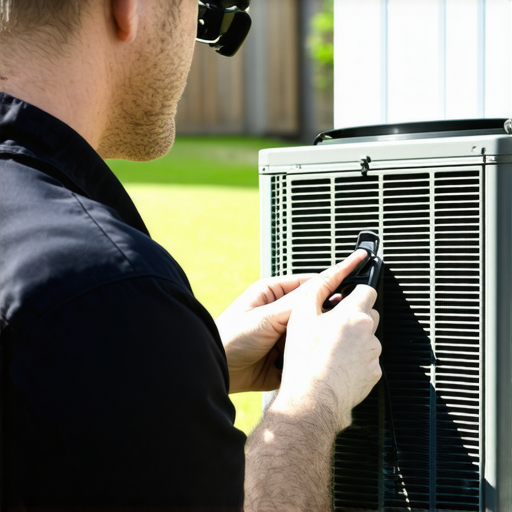
It’s 108 degrees in the shade, the kind of heat that makes the asphalt soft and the cicadas louder than a jet engine. You’re sitting in your living room, and suddenly, the familiar hum of your air conditioner changes. It’s no longer a confident roar; it’s a desperate, metallic buzz—like a swarm of angry bees trapped in a tin can. As a technician who has spent three decades dragging my manifold gauges through cramped attics and over scorching rooftops, I can tell you that sound is the death rattle of a capacitor. Most folks ignore it until the house hits 85 degrees, but by then, you’re not just looking at a small part; you’re looking at a potential compressor burnout or a full blower motor replacement.
The Narrative: I Caught the ‘Sales Tech’ Red-Handed
Last August, I followed a ‘Comfort Advisor’—which is just a fancy name for a salesman in a clean polo shirt—to a house where he’d just quoted a family $18,000 for a full heat pump replacement. He told them their compressor was ‘internally grounded’ and the system was a ‘total loss.’ I walked up to that condenser, pulled the service disconnect, and discharged the residual energy. I looked at the dual-run capacitor. It was bulged like a can of spoiled tuna. I swapped in a $40 American-made 45+5 MFD capacitor, tightened the terminals, and that unit kicked on and hummed like it was brand new. He wasn’t a tech; he was a shark. This is why you need to understand the physics of your system before you sign a financing contract.
“The most expensive equipment in the world cannot overcome a bad duct system or a technician who doesn’t understand electrical load.” – Industry Axiom
The Science of the ‘Kickstart’
Your AC unit runs on a single-phase electrical supply, but your motors—both the compressor and the fan—need a bit of ‘fake’ three-phase power to get moving. In this Southwest heat, sensible heat is the enemy. When the ambient temp hits 115°F, the head pressure in your lines skyrockets. The capacitor acts like a temporary battery, providing the ‘torque’ needed to overcome that pressure and get the motor spinning. Without it, the motor just sits there, stalled, drawing ‘Locked Rotor Amps’ (LRA). That’s the buzzing you hear. It’s the sound of electricity trying to move a mountain it can’t budge. If you let it buzz too long, you’ll cook the windings, and then you really will need financing for heat pump installs because your compressor will be toast.
Sign 1: The ‘Angry Bee’ Buzz and Delayed Starting
The first sign is often subtle. You might notice the outdoor fan is spinning, but the compressor—the heart of the machine—isn’t kicking in. Or perhaps the fan itself is struggling to start. In 2026, with the transition to A2L refrigerants like R-454B, systems are more sensitive to voltage fluctuations. If you hear that 60Hz hum without the mechanical thud of the compressor engaging, your capacitor has likely lost its ‘juice’ (capacitance). We measure this in microfarads. If a capacitor is rated for 45 microfarads and it’s only pushing 38, it’s a dead man walking. This is why static pressure testing is vital during your annual check-up; if your motor is fighting restricted airflow from a dirty coil or a clogged duct, it draws more amps, which cooks the capacitor even faster.
Sign 2: The Physical ‘Mushroom Top’
If you’re brave enough to peek inside the service panel (after pulling the disconnect, Sparky!), look at the top of the silver cylinder. A healthy capacitor is flat on top. A failing one will bulge or ‘mushroom.’ This is a safety feature designed to break the internal connection before the pressurized oil inside sprays everywhere. If you see oil leaking or a rounded top, stop. Do not pass go. This is a primary indicator that the dielectric fluid inside has overheated. In our region, high ambient temperatures are the number one killer of these components. Many homeowners opt for priority service memberships just so a pro can catch these bulges during a spring ‘tune-up’ before the first heatwave hits.
Sign 3: Short Cycling and Tripped Breakers
Does your unit turn on for three minutes and then quit? That’s short cycling. The capacitor might have enough life to start the motor, but it can’t maintain the phase shift required to keep it running under load. The motor gets hot, the internal thermal overload switch trips, and the unit shuts down to save itself. Worse yet, if the capacitor is completely shot, the motor will draw so much current trying to start that it trips the breaker at the main panel. Don’t just flip the breaker back on. You’re forcing a stalled motor to eat raw amperage. This often happens in industrial heater services and large residential units alike.
“All electrical connections shall be checked for tightness; loose connections cause heat, which leads to component failure.” – ASHRAE Standard 15
The 2026 Reality: Rebates and New Tech
We are in a new era of HVAC. With the EPA’s 2025/2026 mandate on low-GWP refrigerants, the cost of ‘gas’ (refrigerant) is changing. If your system is over 12 years old and the capacitor failure has caused motor damage, it might be time to look at rebate application assistance for a new high-efficiency heat pump. These new units often use inverter-driven compressors that don’t even use traditional capacitors, but they require specialized hospital HVAC zoning logic to keep the air moving correctly. If you are stuck with an older R-410A system, keeping your coils clean and ensuring regular furnace filter replacement is the only way to keep your head pressure down and your capacitor cool.
Why Airflow is Still King
I’ve said it a thousand times: you can’t cool what you can’t touch. If your ductwork is a mess of ‘Pookie’ (mastic) and silver tape, your blower motor has to work twice as hard. This puts immense strain on the run capacitor. When we perform furnace repair services, we aren’t just looking at the flame; we’re looking at the total external static pressure. High pressure means high heat, and high heat means a dead capacitor. If you’re feeling a ‘cold swamp’ vibe in your house, your unit might be oversized or your airflow might be choked. Check your filters. It’s the simplest preventative heating maintenance you can do.
Don’t be the person who pays $15,000 because they didn’t know how to spot a $40 part failure. If you hear the buzz, contact us immediately. We believe in fixing things right, not just ‘selling’ you a new box. For more tips on keeping your old horse running, check out our guide on top HVAC repair strategies or learn about the latest heat pump solutions for the coming year.