The 30-Year Truth: Why Your Thermostat Is Just a Dumb Switch
I’ve spent three decades dragging my tool bag through sub-zero crawl spaces and dodging wasps in attic fan housings. In that time, I’ve learned one immutable truth: your furnace doesn’t care about you. It only cares about the circuit being closed. For years, the ‘dumb’ thermostat was just a bimetallic strip that clicked together when it got cold, telling your gas valve to open and your igniter to glow. But we’re entering a new era. My old mentor used to scream, ‘You can’t heat what you can’t touch!’ This is why airflow matters more than horsepower. If you are heating a house where nobody is home, you aren’t just wasting ‘juice’ (electricity) or ‘gas’; you are putting unnecessary cycles on your draft inducer motor and stressing your heat exchanger for no reason. Integration with Google Home and similar AI ecosystems isn’t about being fancy; it’s about forcing the laws of thermodynamics to work on your schedule, not the weather’s.
“The most expensive equipment in the world cannot overcome a bad duct system or a poorly controlled thermal cycle.” – Industry Axiom
The Physics of the ‘Empty House’ Drain
When you leave your heating system running at 72°F while you’re at the office, you are fighting a losing battle against heat transfer. Heat moves toward cold—always. Your walls, windows, and that tiny gap under your door are constantly shedding the energy you paid for. By the time you get home, your system might have cycled twenty times. In a cold climate like Chicago or the Northeast, that means twenty instances of your draft inducer motor spinning up to purge the combustion chamber. If you haven’t looked into top hvac repair strategies to extend your systems life, you’re likely ignoring the wear and tear these cycles cause. Smart integration uses geofencing to realize you’ve left a five-mile radius and immediately drops the setpoint. We call this ‘setback logic.’ For every degree you drop, you’re slowing the rate of heat loss through the building envelope. It’s not magic; it’s math.
The Mechanical Anatomy: Why Integration Prevents Breakdowns
As a tech, I hate ‘Sales Techs’ who try to sell you a whole new system because a wiring repair for heating systems was actually the culprit. However, I do advocate for smart controls because they act as a diagnostic watchdog. When your Google Home system realizes it’s taking 40 minutes to raise the temp 2 degrees instead of the usual 15, it knows something is wrong before you do. It might be a failing air handler repair issue or a clogged filter increasing static pressure. In multi-family dwellings, this is even more critical. We are seeing a massive surge in multi-family heating upgrades where centralized Google Home hubs manage 20+ units, ensuring that a tenant doesn’t leave a window open while the heat is cranking, which can lead to a frozen coil or a cracked heat exchanger from constant limit-switch tripping.
Draft Inducer Motors and the Cost of Ignorance
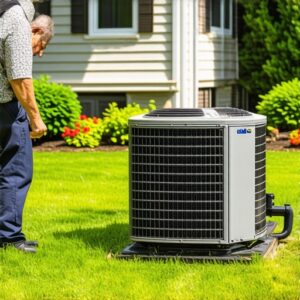
The draft inducer motor repair is one of the most common mid-winter calls I get. These motors are the ‘canary in the coal mine.’ They start up before the burners to clear out any residual gases. If your system is cycling constantly because your thermostat is poorly placed or ‘dumb,’ that motor’s bearings are going to scream like a banshee before they finally seize. By integrating smart sensors in every room, you can average the temperature across the house. No more ‘hot’ or ‘cold’ spots in crawl space heating solutions where the pipes are at risk of bursting. You can actually prioritize the rooms you are in, rather than the hallway where the old thermostat usually sits. If you’re serious about your equipment lasting, look into preventative heating maintenance to ensure your sensors and wiring are talking to each other correctly.
“Design heating loads shall be determined in accordance with the procedures described in the ASHRAE Handbook of Fundamentals.” – ASHRAE Standard 62.1
The 2025 Regulatory Cliff: R-454B and Smart Logic
We are facing the ‘Death of R-410A’ and the transition to A2L refrigerants like R-454B. These new gases are ‘mildly flammable,’ which means the new systems coming in 2025 will have even more sensors than your car. This makes HVAC load calculation services more vital than ever. If your unit is oversized, it will ‘short cycle,’ which is the fastest way to kill a compressor. Smart integration helps mitigate this by managing the staging of your furnace or heat pump more effectively than a human ever could. For those looking for the ultimate efficiency, solar thermal heating integration combined with ductless mini-split installation allows you to micro-zone your home. You can heat the nursery to 70 and the kitchen to 62, all while the Google Home app tracks your energy savings. This is the only way to stay ahead of the skyrocketing costs of ‘gas’ and ‘juice.’
IAQ and The Breathable Truth
Integration isn’t just about temperature; it’s about IAQ improvement services. Modern smart systems can monitor VOCs and humidity. In the dead of winter, when the air is dry enough to crack your skin, a smart system can trigger your humidifier only when needed, preventing the ‘science experiment’ (mold) from growing in your ducts because of over-saturation. If you are unsure which tech to trust with these complex installs, I recommend choosing the best heating service by looking for ‘tin knockers’ who actually understand static pressure, not just guys who can swap a capacitor and call it a day. Stop heating your empty house; start managing your home’s thermodynamic profile. Your wallet and your draft inducer motor will thank you.