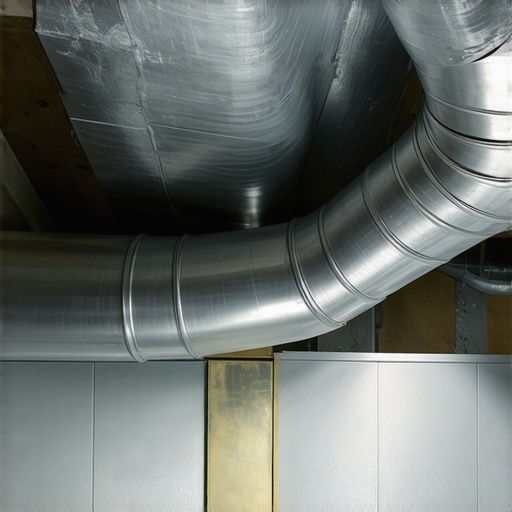
The Invisible Skeleton: Why Airflow Dictates Your Comfort
My old mentor, a man who had more soot in his lungs than a Victorian chimney sweep, used to scream at me every time I reached for my manifold gauges too early. ‘You can’t cool what you can’t touch, and you can’t heat what you can’t move!’ he’d bark, his voice raspy from decades of breathing in attic dust. He was right. Most homeowners think the metal box in their basement or attic is the hero of the story, but the real champion—or the villain—is the ductwork. If your ducts aren’t sized correctly, your brand-new, high-efficiency furnace is just an expensive paperweight. I’ve seen 20-year-old units outperform shiny new 2025 models simply because the tin knocker who installed the original system actually knew how to calculate static pressure instead of just ‘eyeballing it.’ This is the heart of professional duct design.
“The most expensive equipment in the world cannot overcome a bad duct system.” – Industry Axiom
The Physics of the ‘Ghost Whistle’ and Static Pressure
Have you ever heard a high-pitched whistling coming from your vents when the heat kicks on? That’s not a ghost; it’s physics screaming for help. In the HVAC world, we call this high static pressure. Think of your ductwork like the arteries in your body. If they are too narrow, your heart (the blower motor) has to work twice as hard to pump the same amount of ‘blood’ (air). Eventually, that heart is going to give out. When I perform an HVAC repair, I often find that the blower motor didn’t just die—it was murdered by a return air drop that was three inches too small. When air is forced through a restriction, its velocity increases, creating that whistling noise. More importantly, it creates a massive resistance that forces the motor to draw more amps, heating up the windings until the insulation melts and the motor shorts out. Professional duct design ensures your ‘arteries’ are sized for the volume of air your system is designed to move.
Thermodynamic Zooming: The Density of Heat
Let’s talk about Thermodynamic Zooming. In cold climates like the Northeast or Chicago, we deal with sensible heat transfer at a high delta-T. When your furnace fires up, the heat exchanger becomes a blistering hot obstacle course for your air. If the airflow is too slow because of poor duct design, the air stays in contact with the heat exchanger for too long. It gets too hot, which might sound good, but it actually causes the furnace to hit its ‘limit switch.’ This is a safety feature that shuts the burners off to prevent the heat exchanger from cracking. You’ll notice this as ‘short cycling’—the furnace turns on and off every five minutes, but the house never feels warm. Proper attic insulation for heating helps retain that warmth, but if the air isn’t reaching the rooms because of a ‘dead-head’ in the supply trunk, you’re just heating your crawlspace. This is why a professional audit of your ductwork is essential before considering an oil to gas conversion or installing heat pump solutions for efficient home comfort in 2025.
The Smell of Failure and the Chimney Connection
When I walk into a house where the ductwork is failing, I don’t just use my eyes; I use my nose. There is a specific, metallic, scorched-dust smell that occurs when a system is ‘choked.’ If your ducts are undersized, the heat exchanger stays consistently hotter than it was engineered to be. This speeds up the oxidation of the metal. If you are running an older gas or oil system, this restricted airflow can even interfere with the draft. I’ve seen cases where poor duct design caused enough backpressure to affect the flue gases, making a chimney liner installation or a pilot light relighting service only a temporary fix for a much deeper ventilation problem. In commercial settings, such as hotel boiler services, we see this magnified; if the air handling units can’t dump their heat into the zones, the boilers short-cycle and fuel bills skyrocket.
“Airflow is the primary medium for heat transfer in residential environmental control systems; without proper volumetric flow, rated equipment capacities are unreachable.” – ACCA Manual D Principles
Static Pressure: The Silent Killer of Modern Systems
Modern equipment, especially geothermal heat pump systems and high-efficiency furnaces, are more sensitive than the old ‘belt-drive’ monsters of the 70s. Those old blowers would just keep spinning until the motor smoked. Today’s ECM (Electronically Commutated Motors) are ‘smart.’ If they sense high static pressure, they will ramp up their RPMs to try and deliver the requested CFM (Cubic Feet per Minute). This sounds great until you realize they are consuming three times the electricity and sounding like a jet engine taking off in your hallway. Professional duct design uses smart building management logic to balance these runs. We look for ‘Pookie’—that’s the gray mastic sealant we use—that has dried up and cracked, or worse, ‘tin knockers’ who used duct tape which eventually fails, leading to massive ‘duct leakage.’ You could be losing 30% of your heated air to the attic before it ever hits your bedroom. If you’re investing in snow melt systems installation for your driveway, you clearly care about efficiency; don’t let your indoor air be the weak link.
The Red Flags: When to Call the Pros
If you find yourself constantly needing pellet stove repair because your central air won’t cut it, or if you have one room that is a meat locker while the other is a sauna, your duct design is the culprit. We often see ‘branch lines’ that are pulled tight like guitar strings or ‘flex duct’ that looks like a bowl of spaghetti in the attic. Every sharp turn in a duct is like a car hitting a brick wall; the air loses momentum. A pro will use a manometer to measure the pressure drop across your coil and filter. If that number is high, no amount of ‘tuning up’ will save you. You need a redesign. This is especially critical when transitioning to new technologies. Before you look at choosing the best heating service expert tips for 2025, ensure they know how to read a friction chart. You want a technician, not a salesman. A real tech will tell you that a $2,000 duct modification will save you more money than a $15,000 25-SEER unit slapped onto a 10-SEER duct system. Comfort is physics, and physics doesn’t care about your marketing brochures.
In conclusion, stop treating your HVAC system like a ‘plug-and-play’ appliance. It is a breathing, pressurized system that requires balance. Whether you are maintaining your system through preventative heating maintenance or planning a total home renovation, start with the ducts. If the bones are bad, the body will never be healthy. Reach out to a professional who values airflow over commissions, and you might find that the ‘broken’ AC you’ve been complaining about just needed room to breathe. Feel free to contact us to discuss your home’s specific airflow requirements.