The Diagnostic Ghost in the Machine: Why Your High-Tech Heat Pump is Acting Like an Ice Cube
I’ve spent thirty years crawling through crawlspaces and sweating out my body weight on rooftops, and if there is one thing that hasn’t changed, it’s that physics doesn’t care about your warranty. You just dropped ten grand on a high-efficiency system, and yet, every forty-five minutes, you hear that ominous whoosh—the sound of the reversing valve shifting—and see a cloud of steam rising from your outdoor unit like a Victorian chimney. You think it’s broken. Your neighbor says it’s ‘just what they do.’ I’m telling you, it’s likely a victim of bad physics and even worse installation.
“The most expensive equipment in the world cannot overcome a bad duct system.” – Industry Axiom
My old mentor, a man who could diagnose a compressor burnout by smell alone (that acidic, metallic tang is unmistakable), used to scream at me, ‘You can’t move what you can’t touch!’ He was talking about airflow. If the air isn’t moving across that outdoor coil because the unit is choked by debris or restricted by a ‘Tin Knocker’ who didn’t understand static pressure, the thermodynamics of the system fall apart. This is the heart of the constant defrost cycle. When we talk about system performance testing, we aren’t just checking the ‘gas’ (refrigerant); we are checking the soul of the machine: its ability to exchange heat.
The Thermodynamic Zoom: Latent Heat and the Dew Point Trap
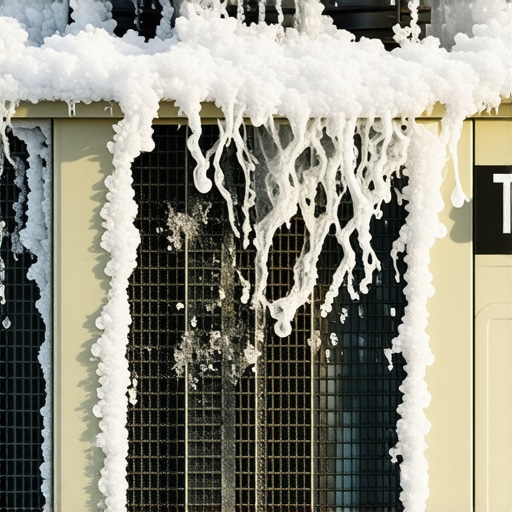
To understand why your unit is freezing, we have to look at the evaporator coil (which, in heating mode, is your outdoor unit). In a cold, humid climate, the outdoor coil drops well below the dew point to extract heat from the ambient air. Yes, even at 35°F, there is heat to be found. But as that moisture hits the sub-freezing fins, it undergoes a phase change. This is latent heat removal in reverse. If the unit is oversized—a common sin committed by ‘Sales Techs’ looking for a quick commission—it reaches the temperature setpoint too fast, causing ‘short cycling.’ This prevents the unit from ever reaching a steady state of equilibrium, leading to rapid ice bridging across the fins. [IMAGE_PLACEHOLDER]
The Anatomy of a Forensic Diagnosis
When I walk up to a unit that’s constantly defrosting, I don’t look at the circuit board first. I look at the MERV filter upgrades. People think they’re doing their lungs a favor by putting in those thick, pleated filters, but without system performance testing, you’re basically putting a plastic bag over your heat pump’s mouth. High static pressure reduces the mass flow of air, which causes the refrigerant (the ‘Juice’) to stay too cold for too long, triggering the defrost sensor prematurely.
“Residential equipment shall be sized in accordance with ACCA Manual J, and duct systems shall be designed per Manual D.” – ACCA Standards
Then there’s the issue of the low-GWP refrigerant retrofits. As we move into 2025, the industry is pivoting to R-454B and R-32. These new refrigerants have different enthalpy characteristics. If your technician didn’t calibrate the superheat and subcooling during the initial heat pump solutions setup, the unit might be ‘hunting’ for a stable pressure, causing the outdoor coil to get significantly colder than it needs to be. This is why warranty service plans are vital; they ensure a veteran actually puts gauges on the system to check the ‘Suction Line’ (which should be ‘beer can cold’ in summer, but properly pressurized in winter) before the compressor takes a permanent dirt nap.
The Dual Fuel Savior and Proper Venting
In the North, where the polar vortex turns air into a solid, a standard heat pump eventually hits its ‘balance point’—the temperature where it can no longer pull enough heat from the air to overcome the house’s heat loss. This is where dual fuel heat pump systems shine. By pairing a heat pump with a gas furnace, the system can switch to ‘Gas’ when the COP (Coefficient of Performance) drops too low. However, I’ve seen flue pipe installation errors where the furnace exhaust is recirculating back into the heat pump’s intake. This messes with the ambient temperature sensor, tricking the unit into thinking it’s colder than it is, leading to—you guessed it—more defrost cycles.
The ‘Pookie’ and the Physics of Airflow
If you want to stop the madness, you have to look at the ductwork. Most ‘Sales Techs’ want to sell you a new $15,000 unit when the problem is a $20 bucket of Mastic (we call it ‘Pookie’). If your return air is pulling unconditioned, damp air from a crawlspace because of a leaky ‘Tin Knocker’ job, you are adding a massive latent load to the system. In cold climates, a humidifier installation can actually help the indoor comfort, but if the house is ‘leaky,’ the heat pump works overtime, frost builds up, and you’re back in defrost hell. For those building new, new construction heating design must include a dedicated ‘Manual J’ calculation to ensure the unit isn’t fighting a losing battle against physics from day one.
When to Call the Pros (And Not the Salesmen)
If your unit is defrosting more than once every 30-60 minutes in temps above 35°F, something is wrong. It could be a failed defrost thermostat, a ‘Sparky’ (electrician) who didn’t provide enough voltage to the ‘contactor,’ or simply a unit that’s starved for air. Don’t let someone talk you into a whole new system without a ‘Manometer’ reading of your static pressure. If you’re tired of the ice age in your backyard, it’s time to look at preventative heating maintenance that actually focuses on the science of airflow, not just the sale of a new box. Whether it’s industrial heater services or a simple residential check-up, the physics remains the same: Respect the airflow, or pay the price in frost.