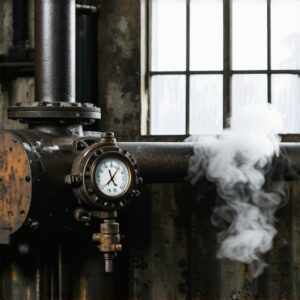
The Eerie Silence of a Dormant Boiler Room
Walk into a school boiler room in mid-July, and you’ll hear something terrifying: absolutely nothing. To the untrained ear, that silence is peaceful. To a tech who has spent thirty years pulling heat exchanger cleaning duty in cramped mechanical rooms, that silence is the sound of impending disaster. While the hallways are being waxed and the lockers are being scrubbed, the most critical organ in the building’s anatomy—the hydronic heating system—is sitting cold, allowing sediment to settle and gaskets to dry out. If you wait until the first frost to ‘see if she fires up,’ you’ve already lost the battle. In the world of high-mass heating, summer isn’t a vacation; it’s the only window you have for a forensic audit before the winter load turns a small hairline fracture into a 200-gallon-per-hour flood.
The Narrative: The ‘Sales Tech’ and the $80,000 Ghost
I remember following a ‘Sales Tech’—one of those guys who carries a shiny iPad and a clean uniform but wouldn’t know a pipe wrench from a pogo stick—into a local elementary school. He had quoted the school board $80,000 for a full boiler replacement because of ‘advanced scale and imminent vessel failure.’ I walked in, looked at the sight glass, and saw the hydronic heating systems were just starving for a proper blowdown and a $500 heat exchanger cleaning. He was trying to sell a new system when all the old girl needed was for someone to actually do the work instead of just looking for a commission. I caught him trying to convince the principal that a small weep at a flange meant the whole cast-iron sectional was toast. I tightened the bolts, replaced the gasket, and that boiler is still humming today, ten years later. That’s the difference between a salesman and a technician. You don’t replace the engine when the oil is just dirty.
“The most expensive equipment in the world cannot overcome a bad duct system—or in the case of hydronics, a poorly maintained distribution loop.” – Industry Axiom
Thermodynamic Zooming: Why Heat Exchangers Fail in the Dark
Let’s get technical. When we talk about commercial furnace repair or boiler audits, we aren’t just looking for leaks. We are looking at the molecular reality of heat transfer. Inside your boiler, the heat exchanger is the interface where the flame’s energy meets the system’s water. Over a long winter, carbon soot and mineral scale build up on these surfaces. This creates a thermal barrier. In a high-efficiency condensing boiler, even a 1/16th inch of scale acts like an insulator, forcing the burner to run hotter and longer to achieve the same Delta T. This leads to thermal shock. When that cold return water hits a metal surface that is overheating due to scale insulation, the metal expands and contracts at violent rates. That is how you get a cracked section. Summer is the time for biomass boiler services and standard gas-fired audits to chemically descale these surfaces. If you aren’t stripping that scale, you’re just burning money through the chimney.
The North Climate Reality: Preparing for the Polar Vortex
Up here in the cold zones, we don’t play games with cold climate heat pumps or boilers. When the ambient temp drops to -15°F, your system isn’t just a luxury; it’s life support for the building’s plumbing. Schools are particularly vulnerable because of their massive footprint. We see a lot of church heating systems and school loops that suffer from ‘dead legs’—sections of pipe where water doesn’t circulate properly. During a summer audit, we check the flow rates and the hydronic heating systems‘ balance. If the water isn’t moving, it’s freezing. We also look at solar thermal heating integration points. If your solar loop isn’t shedding heat correctly in the summer, it can cook the glycol, turning your ‘green energy’ into a corrosive acidic sludge that eats your copper from the inside out.
“Hydronic systems shall be maintained to ensure that heat transfer surfaces are free of scale and deposits that inhibit efficiency.” – ASHRAE Standard 155P
The Anatomy of the Summer Audit: Beyond the Boiler
A real audit covers the entire mechanical ecosystem. This includes pellet stove repair for auxiliary units and biomass boiler services for rural districts using wood chips. But the big one people forget is the air side. We need to talk about MERV filter upgrades. After a year of kids dragging dust and allergens through the halls, those coils are choked. If your school uses unit ventilators (univents), those small internal coils need to be vacuumed and disinfected. If the airflow is restricted, the boiler has to work harder because the heat isn’t being pulled off the water loop effectively. It’s a chain reaction. While we’re at it, we check the ‘Pookie’—that’s the mastic sealant—on any exposed ductwork to ensure the tin knocker who installed it originally didn’t leave any gaps. You can have the most efficient boiler in the world, but if your air handlers are failing, you’re just heating the ceiling joists.
The 2025 Regulatory Cliff and Efficiency Standards
We are entering a new era. With the phase-out of certain refrigerants and the push for higher AFUE (Annual Fuel Utilization Efficiency) ratings, maintenance is no longer optional. For schools looking to modernize, we often discuss heat pump solutions for efficient home comfort in 2025, but on a commercial scale, this involves hybridizing the plant. This means keeping the boiler for those sub-zero nights but using cold climate heat pumps for the shoulder seasons. An audit determines if your current infrastructure can even handle that transition. Is your electrical service ready for the ‘Sparky’ to drop new lines? Is your ‘gas’ (refrigerant) management up to EPA Section 608 standards? These are the questions that save school boards six-figure headaches down the road. For more on extending the life of your current setup, check out these top HVAC repair strategies to extend your systems life.
The Final Word: Physics Doesn’t Take a Summer Break
At the end of the day, a school is a machine for learning, and that machine breaks down when the climate control fails. You don’t want to be the facility manager explaining to a room full of angry parents why school is canceled in January because a $200 pump coupler snapped. Proper preventative heating maintenance is the only insurance policy that actually pays out. By the time the ‘Juice’ is flowing and the thermostats are clicking, it’s too late to fix the foundation. Start your audit in June, finish your repairs in August, and sleep through the first blizzard of the year. If you’re not sure where to start, looking into choosing the best heating service expert tips for 2025 is your first step toward a quiet, warm winter. Don’t let a ‘Sales Tech’ tell you that you need a new system until a real ‘Tin Knocker’ or boiler tech has looked at your heat exchanger with a borescope. Contact the pros for a real assessment through our contact us page before the mercury drops.